
Trevanion
Old Oak
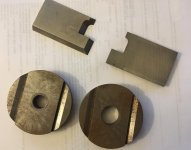
So, a Mr. Guineafowl21 send me some cutter blocks for safekeeping that he had acquired, and I thought they were perfect examples of just how the spindle moulder got its fearsome reputation and worth a little write-up.

Now, these square blocks aren't strictly spindle moulder blocks as they are clearly off a tenoning machine being of a small size with counterbores, but the points still stand nevertheless.
The square cutter block was one of if not the earliest style of cutter block and was a staple of the woodworking industry for many decades until their eventual ban in Britain in 1974 following the Health and Safety at Work Act, for good reason. These blocks are all manner of bad, they are incredibly loud when running owing to the major air disturbance caused by the large projection of the cutters, the large projection of the cutters themselves invokes a serious safety risk as any contact with them would result in a near-instant amputation, and they were very sensitive to imbalance and had to be very carefully and skilfully set to result in smooth running. The block that has the cutters I assume has been left like that after it was taken off the machine, and you can see just how dangerous these could be in the hands of incompetent/ignorant operators.

You might make out from the picture that the cutters are bent backward with wood chips packed between the cutter face and the block, this is a very dangerous state for the block to be in and the scary bit is that this is how it would've been run the last time it spun.


The cutters should lay completely flat against the block face with no discernable gaps anywhere, usually, the culprits of this symptom are serious over-tightening of the cutter bolts and/or serious over-work but I think the main culprit in this case is the former as the cutters appear to be curved along their whole length rather than at the projection.

In the package was included a dovetail bolt which had sheared off at some point, my guess would be from overtightening when setting up but it wasn't uncommon for bolts to shear during running (again, usually from stresses caused by repeated overtightening) which would cause the very heavy cutter (compared to modern thin cutters) to come flying off at ~80mph into whatever was in its path.

An assortment of cutters was included in the package as well, and this large curved one is a prime example of bad practice. The knife has been ground very heavily to the point where it is dangerously thin at the cutter slot where fatigue could cause the cutter to crack in half during running and come out of the block. On this particular example, you can actually see that the slot has splayed open and is no longer parallel, this is also incredibly dangerous as the cutter will no longer hold as effectively under the nut anymore and it has the potential to splay more and eject from the block during running.
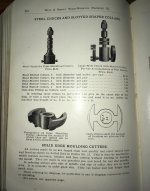
As well as the square cutter block, another common set of cutters you might find in an old wood machining workshop would be a pair of slotted collars. These are a very basic form of cutting apparatus consisting of two spindle spacers with grooves run into them the thickness of standard knife stock. These were a relatively safe piece of equipment to use owing to simplicity of them being two collars and two knifes but they still required very diligent set up as they can still shoot cutters out if not tightened properly, unless they are the pinned type where a groove must be cut into the edge of the cutter to lock it in place. The main benefit of slotted collars over square blocks was the greatly reduced cutting circle, allowing you to get the cutting circle to less than 4" in diameter which was very handy for the moulding tight concave curves such as tangent handrailings in conjunction with a dumpling block mounted on the table (a very dangerous practice) or other work that required a small cutting circle.

Another not-so-common cutter was the French head/cutter with is simply just a slot cut into the middle of a spindle moulder shaft and a cutter inserted into it. These were a niche type of cutter but they did have their merits when working in very hard interlocking timbers because they projected through the centre of the shaft so they had a negative cutting angle and scraped timber rather than cut. Cutters would be made from a mild steel rather than a high-speed or high-carbon steel as the scraping forces would shatter hardened steel during cutting, the mild steel profiles could be ground exactly the shape of the moulding as there was no cutting angle to take into account which was a small benefit. The mild steel would be ground to shape and then turned over to create a burr much like a cabinetmakers card scraper, only light passes could be made with the french head because of the negative angle, heavier cuts would induce chattering and eventually kickback, it was largely used by cabinetmakers rather than the joinery trade although it had its uses in handrailing thanks to its very small cut circle. Some french cutters had grooves cut into the bottom the width of the spindle they sat upon so that they couldn't come loose, but mostly they were simply held in place with a bolt from above, like in this picture of my own:

(a good video of these cutters in action is this silent, black and white video, from about 6:45 onwards: https://www.ina.fr/ina-eclaire-actu/video/vdd10045545/la-fabrication-d-un-siege-a-l-ecole-boulle)
All in all, these blocks and cutters were incredibly dangerous, which is why safer alternatives were introduced such as the Whitehill Block, "The safety cutter of their day" some individuals might say, but then those weren't without their faults either.

Coming about in 1930-31 the Whitehill block was offered as a safer alternative to the infamous square block and was in regular use in workshops up and down the country until 1998 when the Provision and Use of Work Equipment Regulations (PUWER) came into effect and banned them and all other non-chip limiting cutter blocks from use by 2003 (an overnight blanket ban would've been unfair, they gave 5 years for companies to purchase completely new tooling). The Whitehill block was a very versatile tool in the right hands and allowed for much thinner and cheaper cutters to be used as they were fully supported by the circular block during cutting, as opposed to the square blocks thicker cutters relying on their own stoutness.

Thanks to the circular shape of the block, the much lighter cutters, and lesser projection of the cutters, accurate balance was less of a major issue with these blocks compared to the square blocks and a common practice was to grind one knife to the desired profile and then find a slightly heavier cutter which would be inserted deeper into the block so that it wouldn't cut but offer accurate enough balancing so that the machine ran smoothly without vibration, the best practice was to grind two identical knives.
As I said, these blocks weren't without their faults but they were a much more foolproof design than the square cutterblocks, although accidents did commonly occur. The main culprit of accidents with these blocks was not tightening the clamps properly during setup and then starting the machine up, I personally know of someone who took a cutter to the intestine after it ejected from the block from not being tightened up properly. The other culprit was using cutters that were too small to be clamped effectively or clamping too near the edge of the block with very little cutter in the block, which resulted in the cutters being wrenched out during cutting leaving the block damaged and unsafe to use further as it would no longer hold a cutter effectively.


The photos above show a block that has both jaws heavily marred after a double ejection, the worst of which has been ground off by the operator and the block put back to use, a big no-no. With a cutter installed you can see how little surface area of the cutter is in contact the the clamping faces, running this would result in a very high chance of an accident due the knife only being gripped at the very rear of the jaws. The last two photos are from a different block that suffered a similar ejection.

The above picture shows cutters in my collection that are way too small to be run safely in these blocks. At a minimum, the cutter should be as wide as the full height of the cutter block and it should be inserted into the cutter block at least 3/4", the cutters should be firmly clamped but NOT overtightened, over-tightening will cause the block to splay open over time and the cutter will only be gripped at the very back of the jaws causing an ejection during running.
Moving on to modern tooling, there are two safe cutter block types, the Euro-style chip limiting block and serrated chip limiting blocks, Euro-style blocks are far more common than the latter so I'll focus on those.


This particular cutter block is a genuine Whitehill but rebranded for sale by Scott & Sargeant hence "S&S" on the block. It is a very genius design of cutter block as there is very little to go wrong to cause a serious accident like previous generations where cutters could be ejected from the block, the cutters and limiters are held in place by little pins as shown left and right in the above picture, which increases safety, as well as the added benefit of accuracy and repeatability (If you have a good quality block, some cheaper alternatives have inaccurate pins and I even have an example where the pins on the limiter side are too far forward and the limiters engage the work first, terribly made).

The nut and bolt system of the older cutter blocks has been replaced with a small tapered gib which has two grub screws that bear against the cutter block body when tightened which pushes the gib outwards towards the cutters locking them in place, the cutter body and gib are cleverly designed in that the grub screws locate into two recesses which prevent the gib from falling out of the block should someone place the cutters and gib in place and snug up the screws but forget to tighten the screws fully, if the machine is run in this state it is fairly safe as centrifugal force will push the gib outwards onto the cutters. You may notice an odd noise and stop the machine to check if it is very loose but there is next to no risk of anything flying out. Because the gib is tightened with grub screws it is almost impossible to over-tighten these blocks (which only require light tightening) as the grub screw socket will fail before any serious damage is done, as well as the fact these are tightened with a small t-handle allen key, not a spanner which can be leaned on.
The limiters are a very good safety feature also, by having them installed you reduce the effective projection of the cutter to ~1.1mm which is significantly less than without them installed, it means in a single rotation the maximum per cutter that can be removed is 1.1mm (2.2mm total) which helps to prevent serious kickbacks where a cutter with greater projection would take large bites in a fraction of a second and throw it back at the operator with major force, as well as reduce the severity of injuries from operator contact with the cutters as hands do not get pulled into these blocks and you can pull yourself away from the cut whereas unlimited projections would pull you in. You will end up with severe lacerations in a contact with these cutters with limiters installed, but it is nothing compared to the complete amputation that would've occurred with older style tooling.
Hopefully, you found this small article interesting. With modern Euro-style and chip limiting cutter block the spindle moulder is a far safer tool than it has ever been, while there is still an element of danger is it no more dangerous than a router table (I'd personally argue it's less dangerous) or any other piece of woodworking machinery if used safely.
Now, these square blocks aren't strictly spindle moulder blocks as they are clearly off a tenoning machine being of a small size with counterbores, but the points still stand nevertheless.
The square cutter block was one of if not the earliest style of cutter block and was a staple of the woodworking industry for many decades until their eventual ban in Britain in 1974 following the Health and Safety at Work Act, for good reason. These blocks are all manner of bad, they are incredibly loud when running owing to the major air disturbance caused by the large projection of the cutters, the large projection of the cutters themselves invokes a serious safety risk as any contact with them would result in a near-instant amputation, and they were very sensitive to imbalance and had to be very carefully and skilfully set to result in smooth running. The block that has the cutters I assume has been left like that after it was taken off the machine, and you can see just how dangerous these could be in the hands of incompetent/ignorant operators.
You might make out from the picture that the cutters are bent backward with wood chips packed between the cutter face and the block, this is a very dangerous state for the block to be in and the scary bit is that this is how it would've been run the last time it spun.
The cutters should lay completely flat against the block face with no discernable gaps anywhere, usually, the culprits of this symptom are serious over-tightening of the cutter bolts and/or serious over-work but I think the main culprit in this case is the former as the cutters appear to be curved along their whole length rather than at the projection.
In the package was included a dovetail bolt which had sheared off at some point, my guess would be from overtightening when setting up but it wasn't uncommon for bolts to shear during running (again, usually from stresses caused by repeated overtightening) which would cause the very heavy cutter (compared to modern thin cutters) to come flying off at ~80mph into whatever was in its path.
An assortment of cutters was included in the package as well, and this large curved one is a prime example of bad practice. The knife has been ground very heavily to the point where it is dangerously thin at the cutter slot where fatigue could cause the cutter to crack in half during running and come out of the block. On this particular example, you can actually see that the slot has splayed open and is no longer parallel, this is also incredibly dangerous as the cutter will no longer hold as effectively under the nut anymore and it has the potential to splay more and eject from the block during running.
As well as the square cutter block, another common set of cutters you might find in an old wood machining workshop would be a pair of slotted collars. These are a very basic form of cutting apparatus consisting of two spindle spacers with grooves run into them the thickness of standard knife stock. These were a relatively safe piece of equipment to use owing to simplicity of them being two collars and two knifes but they still required very diligent set up as they can still shoot cutters out if not tightened properly, unless they are the pinned type where a groove must be cut into the edge of the cutter to lock it in place. The main benefit of slotted collars over square blocks was the greatly reduced cutting circle, allowing you to get the cutting circle to less than 4" in diameter which was very handy for the moulding tight concave curves such as tangent handrailings in conjunction with a dumpling block mounted on the table (a very dangerous practice) or other work that required a small cutting circle.
Another not-so-common cutter was the French head/cutter with is simply just a slot cut into the middle of a spindle moulder shaft and a cutter inserted into it. These were a niche type of cutter but they did have their merits when working in very hard interlocking timbers because they projected through the centre of the shaft so they had a negative cutting angle and scraped timber rather than cut. Cutters would be made from a mild steel rather than a high-speed or high-carbon steel as the scraping forces would shatter hardened steel during cutting, the mild steel profiles could be ground exactly the shape of the moulding as there was no cutting angle to take into account which was a small benefit. The mild steel would be ground to shape and then turned over to create a burr much like a cabinetmakers card scraper, only light passes could be made with the french head because of the negative angle, heavier cuts would induce chattering and eventually kickback, it was largely used by cabinetmakers rather than the joinery trade although it had its uses in handrailing thanks to its very small cut circle. Some french cutters had grooves cut into the bottom the width of the spindle they sat upon so that they couldn't come loose, but mostly they were simply held in place with a bolt from above, like in this picture of my own:
(a good video of these cutters in action is this silent, black and white video, from about 6:45 onwards: https://www.ina.fr/ina-eclaire-actu/video/vdd10045545/la-fabrication-d-un-siege-a-l-ecole-boulle)
All in all, these blocks and cutters were incredibly dangerous, which is why safer alternatives were introduced such as the Whitehill Block, "The safety cutter of their day" some individuals might say, but then those weren't without their faults either.
Coming about in 1930-31 the Whitehill block was offered as a safer alternative to the infamous square block and was in regular use in workshops up and down the country until 1998 when the Provision and Use of Work Equipment Regulations (PUWER) came into effect and banned them and all other non-chip limiting cutter blocks from use by 2003 (an overnight blanket ban would've been unfair, they gave 5 years for companies to purchase completely new tooling). The Whitehill block was a very versatile tool in the right hands and allowed for much thinner and cheaper cutters to be used as they were fully supported by the circular block during cutting, as opposed to the square blocks thicker cutters relying on their own stoutness.
Thanks to the circular shape of the block, the much lighter cutters, and lesser projection of the cutters, accurate balance was less of a major issue with these blocks compared to the square blocks and a common practice was to grind one knife to the desired profile and then find a slightly heavier cutter which would be inserted deeper into the block so that it wouldn't cut but offer accurate enough balancing so that the machine ran smoothly without vibration, the best practice was to grind two identical knives.
As I said, these blocks weren't without their faults but they were a much more foolproof design than the square cutterblocks, although accidents did commonly occur. The main culprit of accidents with these blocks was not tightening the clamps properly during setup and then starting the machine up, I personally know of someone who took a cutter to the intestine after it ejected from the block from not being tightened up properly. The other culprit was using cutters that were too small to be clamped effectively or clamping too near the edge of the block with very little cutter in the block, which resulted in the cutters being wrenched out during cutting leaving the block damaged and unsafe to use further as it would no longer hold a cutter effectively.
The photos above show a block that has both jaws heavily marred after a double ejection, the worst of which has been ground off by the operator and the block put back to use, a big no-no. With a cutter installed you can see how little surface area of the cutter is in contact the the clamping faces, running this would result in a very high chance of an accident due the knife only being gripped at the very rear of the jaws. The last two photos are from a different block that suffered a similar ejection.
The above picture shows cutters in my collection that are way too small to be run safely in these blocks. At a minimum, the cutter should be as wide as the full height of the cutter block and it should be inserted into the cutter block at least 3/4", the cutters should be firmly clamped but NOT overtightened, over-tightening will cause the block to splay open over time and the cutter will only be gripped at the very back of the jaws causing an ejection during running.
Moving on to modern tooling, there are two safe cutter block types, the Euro-style chip limiting block and serrated chip limiting blocks, Euro-style blocks are far more common than the latter so I'll focus on those.
This particular cutter block is a genuine Whitehill but rebranded for sale by Scott & Sargeant hence "S&S" on the block. It is a very genius design of cutter block as there is very little to go wrong to cause a serious accident like previous generations where cutters could be ejected from the block, the cutters and limiters are held in place by little pins as shown left and right in the above picture, which increases safety, as well as the added benefit of accuracy and repeatability (If you have a good quality block, some cheaper alternatives have inaccurate pins and I even have an example where the pins on the limiter side are too far forward and the limiters engage the work first, terribly made).
The nut and bolt system of the older cutter blocks has been replaced with a small tapered gib which has two grub screws that bear against the cutter block body when tightened which pushes the gib outwards towards the cutters locking them in place, the cutter body and gib are cleverly designed in that the grub screws locate into two recesses which prevent the gib from falling out of the block should someone place the cutters and gib in place and snug up the screws but forget to tighten the screws fully, if the machine is run in this state it is fairly safe as centrifugal force will push the gib outwards onto the cutters. You may notice an odd noise and stop the machine to check if it is very loose but there is next to no risk of anything flying out. Because the gib is tightened with grub screws it is almost impossible to over-tighten these blocks (which only require light tightening) as the grub screw socket will fail before any serious damage is done, as well as the fact these are tightened with a small t-handle allen key, not a spanner which can be leaned on.
The limiters are a very good safety feature also, by having them installed you reduce the effective projection of the cutter to ~1.1mm which is significantly less than without them installed, it means in a single rotation the maximum per cutter that can be removed is 1.1mm (2.2mm total) which helps to prevent serious kickbacks where a cutter with greater projection would take large bites in a fraction of a second and throw it back at the operator with major force, as well as reduce the severity of injuries from operator contact with the cutters as hands do not get pulled into these blocks and you can pull yourself away from the cut whereas unlimited projections would pull you in. You will end up with severe lacerations in a contact with these cutters with limiters installed, but it is nothing compared to the complete amputation that would've occurred with older style tooling.
Hopefully, you found this small article interesting. With modern Euro-style and chip limiting cutter block the spindle moulder is a far safer tool than it has ever been, while there is still an element of danger is it no more dangerous than a router table (I'd personally argue it's less dangerous) or any other piece of woodworking machinery if used safely.