• Hi all and welcome to TheWoodHaven2 brought into the 21st Century, kicking and screaming! We all have Alasdair to thank for the vast bulk of the heavy lifting to get us here, no more so than me because he's taken away a huge burden of responsibility from my shoulders and brought us to this new shiny home, with all your previous content (hopefully) still intact! Please peruse and feed back. There is still plenty to do, like changing the colour scheme, adding the banner graphic, tweaking the odd setting here and there so I have added a new thread in the 'Technical Issues, Bugs and Feature Requests' forum for you to add any issues you find, any missing settings or just anything you'd like to see added/removed from the feature set that Xenforo offers. We will get to everything over the coming weeks so please be patient, but add anything at all to the thread I mention above and we promise to get to them over the next few days/weeks/months. In the meantime, please enjoy!

Blue Spruce Coping Saw

Andy Kev.

Nordic Pine
Joined
Jan 4, 2021
Messages
722
Reaction score
59
I'm sure we've all heard of Blue Spruce tools: beautiful but hugely expensive chisels, for instance. I'd never buy one of those because they're just too pretty to use.

I have just received the Classic Hand Tools news letter and it describes this new coping saw from Blue Spruce:

https://www.youtube.com/watch?v=-iYizYK9saI

It is also very pricey but I have to say that I'm impressed. I don't need one as I have perfectly good fretsaws but it looks so good that I can see myself weakening come Christmas bonus time. Is anybody else impressed by it?
 
I'm just not sure that it can do anything my £1 bargain-bin coping saw can't do.
 
Nice engineering, but doesn’t do anything more than my cheap ones.
Whilst on the subject, I’m running out of blades inherited from my dad, any recommendations?
 
Wowser, that makes the Knew concepts ones look cheap!

re blades: I used to hate using my coping and fret saws but I bought some Pegas blades (#7 for the jeweller's saw) and they work much better than whatever I had before. That's not to say that the Pegas ones are better than anything else on the market: it's just as likely that whatever ones I had before were a particularly bad example (I think the pack came from B&Q about 20 years ago).
 
I didn't even check the price of this.... I'm guessing it would be silly. I purchased my Eclipse coping saw when I was eleven years old. What's the big deal with a coping saw anyway? not intended to be particularly precise?
Its just trying to solve a problem that doesn't exist.
edit: 275? WHAT THE?
 
These elaborate coping saws puzzle me. You don't even need a particularly rigid frame providing you put the blade in the right way round. It's like putting a brass back on a Japanese saw !
 
I won't be buying one, but I do love my Blue Spruce paring chisels I bought in 2008 and had Dave deliver them to a hotel in Philadelphia when my wife was there on business. I paid the $ price and no shipping/import so saved a ton on them for a 6 chisel set and two skews. :eusa-dance:
 
Phil Pascoe":37wwqk2l said:
I seem to remember a thread an age ago - it was about 50/50 on which direction the blade was used. I've not tried pushing one.
If you try to set up a cheap coping saw to push cut, you'll see why people who want to cut on the push stroke (or who naively set them up that way based on other western saws and don't think of reversing it) get tempted by these expensive versions. The cheap ones work fine on the pull stroke, because the pulling action keeps the blade tensioned on its own, but are an exercise in frustration on the push.
 
When I need to use a coping saw (which is rarely) my old bog standard Eclipse does everything I need, but my 'go to' for finer work is a Knew Concepts fret from WH which is a very tidy bit of kit - Rob
 
Both the videos linked to have misinformation and/or incorrect information. What is a valid point is that the Blue Spruce, while gorgeous to look at, is fincky to use and expensive. What is incorrect about choosing a New Concept fretsaw - for dovetailing - is that depth of cut is important: the NC blades turn to 4 degrees, and then you can cut any distance. Choose smaller (e.g. 3" rather than 8") as the swing weight is lower and balance is better.

There are two types of saws, and often are used interchangeably, but they are still different. The coping saw uses a heavier duty blade than a fretsaw (or jewellers saw), can cut more rapidly owing to larger teeth, can better in thicker wood (owing to thicker blade), but a fretsaw is the one to go to for finer cuts and tighter turns (such as the socket of a dovetail).

I am somewhat biased towards New Concept fretsaws for woodworkers as I helped design the saws. How I met and worked with Lee Marshall, and how the saws came about, is documnted here: http://www.inthewoodshop.com/ToolReview ... etsaw.html

I was ot involved with the birdcage design, but wrote a piece here: http://www.inthewoodshop.com/ToolReview ... etsaw.html

Here is a short video I made on using the NC fretsaw:

https://m.youtube.com/watch?v=M6O4rY_0zQs

Regards from Perth

Derek
 
derekcohen":6xiru46o said:
.......There are two types of saws, and often are used interchangeably, but they are still different. The coping saw uses a heavier duty blade than a fretsaw (or jewellers saw), can cut more rapidly owing to larger teeth, can better in thicker wood (owing to thicker blade), but a fretsaw is the one to go to for finer cuts and tighter turns (such as the socket of a dovetail).......

I suggest these are etymological differences only, and that you're dancing on the head of a pin. The only differences you talk about are entirely about the blades, which even on your definition would suggest that putting a thicker coarser blade in a fretsaw would convert it into a coping saw (and the converse: putting a finer blade in a coping saw would turn it into a fretsaw). Take the blades out and lay a fret saw alongside a coping saw, and I doubt there will be any discernible difference at all.

I suspect we have the same tool called different things by people doing different jobs with it. Someone coping with the saw would call it a coping saw, and someone doing fretwork would call it a fret saw. Someone doing a third job such as cutting away waste in dovetails can call it a coping saw, a fret saw, or a small bow saw, and be correct in whatever choice he made.
 
Mike G":b84h2qgw said:
derekcohen":b84h2qgw said:
.......There are two types of saws, and often are used interchangeably, but they are still different. The coping saw uses a heavier duty blade than a fretsaw (or jewellers saw), can cut more rapidly owing to larger teeth, can better in thicker wood (owing to thicker blade), but a fretsaw is the one to go to for finer cuts and tighter turns (such as the socket of a dovetail).......

I suggest these are etymological differences only, and that you're dancing on the head of a pin. The only differences you talk about are entirely about the blades, which even on your definition would suggest that putting a thicker coarser blade in a fretsaw would convert it into a coping saw (and the converse: putting a finer blade in a coping saw would turn it into a fretsaw). Take the blades out and lay a fret saw alongside a coping saw, and I doubt there will be any discernible difference at all.

I suspect we have the same tool called different things by people doing different jobs with it. Someone coping with the saw would call it a coping saw, and someone doing fretwork would call it a fret saw. Someone doing a third job such as cutting away waste in dovetails can call it a coping saw, a fret saw, or a small bow saw, and be correct in whatever choice he made.

:text-+1: Wot Mike said - Rob
 
This forum is generally focused on woodworking forum, so I suggest that any discussion of coping saws should mostly be about woodworking.

Coping saws are used when we need to scribe one surface to fit another. For example, fitting cabinetry to an uneven wall. I don't think any working joiner would think a £270 hand tool a worthwhile purchase. (They'd probably use a powered jigsaw.) It would be normal to clean up the sawcut with a spokeshave, scraper or abrasives.

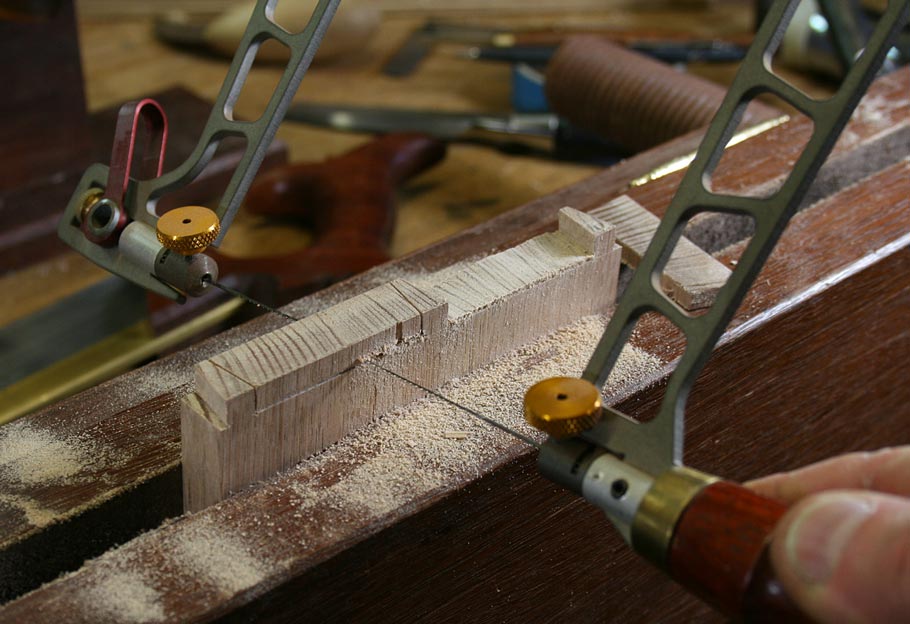
Another frequent use is to remove the waste between the parts of through dovetails.

For that job, I believe that good practice is to saw away from the line, to remove the bulk, then finish off by paring with a chisel.

If the cut does not need to be on the line, I don't see the point of a more precise saw, or an especially fine blade.
 
derekcohen":3isa2jej said:
Tell this to a jeweller :?

Regards from Perth

Derek

I'm not sure where jewellers come into the discussion, Derek. They neither cope nor do fretwork, and so would be using a jeweller's saw.....a somewhat different beast.
 
Ask a jeweller to use a coping saw for their work ... after all it was stated here this is the same as a fretsaw ("etymological differences only"). I was making a silly comment to a sillier response to my earlier post.

I am puzzled by the reaction to my earlier post. I thought that I was offering useful information, plus something practical ... and now I am being attacked. ????

Regards from Perth

Derek
 
AndyT":2drapqwd said:
If the cut does not need to be on the line, I don't see the point of a more precise saw, or an especially fine blade.

I think the difference comes with Japanese saws, which have a finer kerf. My coping saw (with the thicker, slightly longer blade with pins in the end) won't go down into the kerf from my dozuki. My fretsaw (with thinner bdade held in clamps) will. With the coping saw, I'd rough cut dovetail waste by starting in the middle, cutting down & to the side & then doing a second cut to get rid of the waste. With a fretsaw it all goes in one cut.

I'd imagine that with the thicker kerf of a western saw, either would work as well.
 
Dr.Al":3owkojor said:
AndyT":3owkojor said:
If the cut does not need to be on the line, I don't see the point of a more precise saw, or an especially fine blade.

I think the difference comes with Japanese saws, which have a finer kerf. My coping saw (with the thicker, slightly longer blade with pins in the end) won't go down into the kerf from my dozuki. My fretsaw (with thinner bdade held in clamps) will. With the coping saw, I'd rough cut dovetail waste by starting in the middle, cutting down & to the side & then doing a second cut to get rid of the waste. With a fretsaw it all goes in one cut.

I'd imagine that with the thicker kerf of a western saw, either would work as well.

Even my Knew Concepts saw blade won't drop into the kerf from my Japaneses saw :shock: so it's a two stage process to remove dovetail pin waste - Rob
 
AndyT":1x2t8o6j said:
.....
Another frequent use is to remove the waste between the parts of through dovetails.

For that job, I believe that good practice is to saw away from the line, to remove the bulk, then finish off by paring with a chisel.

If the cut does not need to be on the line, I don't see the point of a more precise saw, or an especially fine blade.

Paring to the line in dovetailing is generally a sign of inexperience as it is inefficient.

Sawing to the lines, and then fretsawing along the baseline makes for both efficiency and less tearout. The less waste along the baseline, the less the need to chop away wider waste. Chopping wider waste will dull edges and result in chunks missing from the socket base.

1. First create a chisel wall ...

ThroughDovetails3_html_6ebe88a1.jpg


2. Remove the waste as close to the base line as possible. A fretsaw enables you to do this in one stroke, and from corner to corner. A coping saw does not turn corners very well ...

ThroughDovetails3_html_m46d81eff.jpg


3. Hardly any waste to remove. Less work for the chisel. Better finish ...

ThroughDovetails3_html_2a161e0e.jpg


Regards from Perth

Derek
 
Woodbloke":3f05sw4t said:
....
Even my Knew Concepts saw blade won't drop into the kerf from my Japaneses saw :shock: so it's a two stage process to remove dovetail pin waste - Rob

It is not the "Knew Concepts saw blade" - it is the saw blade you are using in the Knew Concepts saw. Is this a coping or fret saw? If the latter, find a thinner blade. They are available, usually from jewellery suppliers.

Regards from Perth

Derek
 
derekcohen":nlm2395u said:
Woodbloke":nlm2395u said:
....
Even my Knew Concepts saw blade won't drop into the kerf from my Japaneses saw :shock: so it's a two stage process to remove dovetail pin waste - Rob

It is not the "Knew Concepts saw blade" - it is the saw blade you are using in the Knew Concepts saw. Is this a coping or fret saw? If the latter, find a thinner blade. They are available, usually from jewellery suppliers.

Regards from Perth

Derek

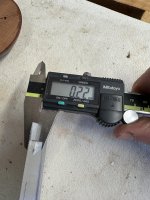
My dovetail saw is a hand made Japanese one from Workshop Heaven with a blade thickness of 0.22mm and virtually no set:

IMG_1630.jpeg

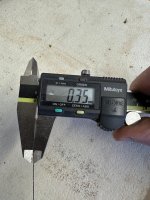
The standard jeweller's blade that I used to fit in my old jewellers fret saw has a thickness of 0.35mm:

IMG_1631.jpeg

...and even if I were Harry the Pothead with a magic wand, they ain't going to fit :lol: - Rob
 
As I wrote, Rob, get a thinner blade. They are available.

I use thin-kerf Western saws (about the same as that fretsaw blade), however I also use Japanese saws, and the blades I use will run down the kerf - not without some force, but this does no damage to the result.

Regards from Perth

Derek
 
derekcohen":1o4j72t7 said:
As I wrote, Rob, get a thinner blade. They are available.

I use thin-kerf Western saws (about the same as that fretsaw blade), however I also use Japanese saws, and the blades I use will run down the kerf - not without some force, but this does no damage to the result.

Regards from Perth

Derek

Why bother? I use a Pegas blade in my KC saw as recommended by Workshop Heaven and it's as easy to take out the dovetail waste using two cuts, firstly down the centre into the lh corner and then along the bottom into the rh corner. It also means I don't have to wiggle the blade through a 90deg bend. Works for me - Rob
 
I may be stating the obvious but let's agree that one of the pleasures of woodworking is that there are so many different ways to go about any procedure. Which one we choose will depend on many factors, including
- the sort of thing being made and its scale (from an earring to a sailing ship)
- the timber in use
- the experience of the worker
- the time available
- the space and workshop equipment
- the money for tool purchase, storage and maintenance

and plenty more that I've not thought of.
 
AndyT":eof0fjcq said:
I may be stating the obvious but let's agree that one of the pleasures of woodworking is that there are so many different ways to go about any procedure. Which one we choose will depend on many factors, including
- the sort of thing being made and its scale (from an earring to a sailing ship)
- the timber in use
- the experience of the worker
- the time available
- the space and workshop equipment
- the money for tool purchase, storage and maintenance

and plenty more that I've not thought of.

:text-+1:

Horses for courses and other similar clichés.
 
by AndyT » Yesterday, 15:22

I may be stating the obvious but let's agree that one of the pleasures of woodworking is that there are so many different ways to go about any procedure. Which one we choose will depend on many factors, including
- the sort of thing being made and its scale (from an earring to a sailing ship)
- the timber in use
- the experience of the worker
- the time available
- the space and workshop equipment
- the money for tool purchase, storage and maintenance

and plenty more that I've not thought of.
:text-+1: :text-goodpost:
 
Back
Top