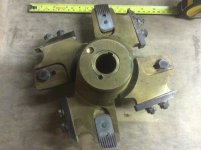
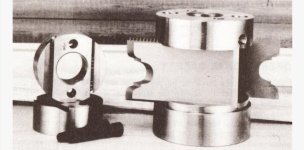
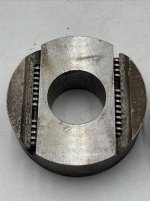
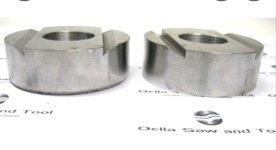
seeing these blocks an cutters bring back bad memories as an apprentice i refused to use the spindle moulder as it was almost unguarded didnt help that the old guy i worked with would tell stories of the accidents that he had seen in other workshops . the one bit of advice that stuck with me was never stand in front of the machine when you turn it on he then proceeded to tell me of the day he had set the spindle up moved to the side and turned it on for the clamp to fail and a cutter shot forty feet across the shop and went through 20 sheets of 3/4 blockboard found it in the 21st . when i went on to study for my advanced cert in college they had a rogues gallery of cutters and bolts from square blocks there was one bolt that had stretched twice its length cutters bent 90 degrees horror stories !
I'm always a bit cynical of "workshop horror" stories like that after hearing so many that are so ludicrous that they can't possibly be feasible, like a cutter punching a hole through a solid concrete block wall and embedding in a vehicle outside... Obviously, if a cutter is let loose, particularly the larger square block cutters they have a significant amount of mass and the speed they are moving could cause serious damage, but I do think stories are significantly overplayed to scare young workers. I've yet to hear a genuine first-hand account with evidence; it's almost always a secondhand or thirdhand account of an accident that had happened decades ago, and there's no photographs or case studies in the case of stories of fatalities. I once heard of a cutter striking the spindle moulder operator in the head and killing him instantly on the spot, I have no idea how one would get struck in the head because the cone area of the cutter coming loose would be horizontal from the shaft, not diagonal towards the head.
Generally, you will want to spin a square block at around 4800RPM or less. With a 3” square block (105mm corner to corner) with cutters that have a 40mm projection as I had set up in the video in a previous post, you have a total cut diameter of around 165mm, at 4800RPM the rim speed at the edge of the cutters is around 93MPH. That is fast, and if the cutters did come loose it would cause some serious damage to the machine if it ejects inside the hood, or if you're unfortunate enough that it ejects in the narrow window in the fence plates it could be catastrophic if it hits the operator. However, even if you're using a cutter that's on the heavier side, with the average cutter being about 300g or so, say you're using one that's 500g, the kinetic energy of the cutter would be in the region of 400 joules. A full metal jacket 9mm bullet has a kinetic energy of around 500 joules, and even with the extreme concentration of the bullet it will not break through a concrete block, nor will it pierce many sheets of plywood, with examples online of it only piercing 6 sheets. The sheer size of the cutter and the fact that it would probably be tumbling through the air rather than in a straight path like a bullet makes me believe that it would simply bounce off anything remotely hard, obviously with quite the bang, and with it tumbling through the air it would lose significant momentum after forty feet, if it could fly that far.
I would like to get a cheap scrap spindle moulder or make a DIY version one day and set up an experiment to see if a cutter would indeed fly that far if let loose, and if it would pierce through 2" of timber clamped around the table. The heavier cutters probably will cause some serious damage but you also hear stories of the much smaller and lighter Whitehill cutters breaking through walls too; I have doubts whether they would even pierce a single sheet of 12mm plywood.
It's the same as the stories you have of metal lathe chucks launching chuck keys across a workshop and embedding in a wall, most lathe and chuck combinations with a key installed will not complete a full revolution without the key smashing into the ways. Obviously, there are exceptions like if you're using a particularly small chuck on a larger lathe where the key could clear the ways, or if you're using a gap-bed lathe, but most of the time it will smash into the ways. So if that's the case, unless you're using your key at the rear of the machine for some strange reason, it will only have about less than half a revolution from top dead centre, which is where most people use the key, to the ways. I just can't see a key gaining enough momentum in half a turn to launch it the ridiculous distances people quote and end up embedded in the ceiling or walls, or even going straight through walls. Especially as most lathes are used under 1000RPM. Say on my own lathe, which has a 6" chuck fitted usually, running at around 1000RPM, which I rarely use, the key extends about 6" out of the chuck, the very outer edge of the key would be spinning around 52MPH and the chuck itself turning 17MPH. I'm not sure at what speed it would be thrown out of the chuck at but even if it was 52MPH, I don't see it having enough momentum to travel across an entire workshop and embed in a wall, especially on wind-up.
This video is a good example, it even shows that someone can throw it by hand further than the lathe could.