• Hi all and welcome to TheWoodHaven2 brought into the 21st Century, kicking and screaming! We all have Alasdair to thank for the vast bulk of the heavy lifting to get us here, no more so than me because he's taken away a huge burden of responsibility from my shoulders and brought us to this new shiny home, with all your previous content (hopefully) still intact! Please peruse and feed back. There is still plenty to do, like changing the colour scheme, adding the banner graphic, tweaking the odd setting here and there so I have added a new thread in the 'Technical Issues, Bugs and Feature Requests' forum for you to add any issues you find, any missing settings or just anything you'd like to see added/removed from the feature set that Xenforo offers. We will get to everything over the coming weeks so please be patient, but add anything at all to the thread I mention above and we promise to get to them over the next few days/weeks/months. In the meantime, please enjoy!

Keen Bench Drill

rxh

Sapling
Joined
Nov 29, 2020
Messages
265
Reaction score
365
I recently found this nice little Keen drill press by M C Gooding of Keens Road, Croydon. It was rusty and movement was very stiff.

20260211_193634.jpg
20260211_193700.jpg
20260211_193713.jpg

Some oil got it moving freely and I gave it a quick trial and found I could make 5mm dia, holes in ¼” thick mild steel plate quickly and easily.

20260212_083827.jpg

Although I lived near Croydon for many years, I was not aware of M C Gooding. A little research revealed that they ceased trading in 1959 but I found the drill press in their 1949 catalogue.

20260216_201813.jpg

I set to work to clean up the drill press and this is the result.

20260216_193113.jpg
 
Nice work and looks a practical tool.

But, (I hope you don't mind me asking,) looking at the matching catalogue photo, have you considered taking the paint off the outside of the flywheel and polishing it instead? Or is it too far gone?
 
  • Like
Reactions: rxh
Nice work and looks a practical tool.

But, (I hope you don't mind me asking,) looking at the matching catalogue photo, have you considered taking the paint off the outside of the flywheel and polishing it instead? Or is it too far gone?
Thanks Andy - that's an interesting idea. I think the best way to polish the rim of the flywheel would be to mount it on a lathe. However, there does not seem to be an easy way to remove it. I suspect that it is a shrink fit on the shaft.
 
I thought that might be the case. But usability is what really matters and you have clearly achieved that.
 
  • Like
Reactions: rxh
Apart from the fact that mine had an extra hole bored in the mounting bracket at 90° this looks like the one I regularly use.
The feed rate/resistance is controlled by an adjustable screw on the one I have.
Cheers, Andy
 
  • Like
Reactions: rxh
I understand how the drill goes round, but how does it go down into the workpiece?
Steve, you turn the handle and the chuck descends fairly rapidly until the bit contacts the workpiece. Then the flywheel starts to rotate and cutting begins, the feed rate being controlled by an adjustment screw (as mentioned by Andy toolsntat above). When the hole is complete, you turn the handle in the opposite direction and the chuck is retracted. This photo shows the adjustment screw.

20260217_085153.jpg
 
Thank you. I'd like to see that in action, it looks very clever.
I once had a wheel brace, double-pinion, Jacobs chuck, very good quality. I can't remember the marque, it may have been Record. Green livery, beautiful.
Sadly someone took it. I miss it. I know we have cordless drills these days, but that was a joy to use, especially when doing more delicate drilling, such as countersinking.
S
 
  • Like
Reactions: rxh
I would add that when the bit is in contact with the work, the more force you rotate the handle with, the greater the advancement of the bit you achieve.
 

Attachments

  • Robert Scaife Colne UK.jpg
    Robert Scaife Colne UK.jpg
    205.1 KB · Views: 7
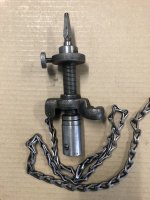
Nearly four years ago (March 29. 2022) I posted a photo of a chain drill branded Robert Scaife. Colne. UK, which uses a very similar advance mechanism as your drill RXH. I've posted another photo of it. I think it uses the 1896 patent of Walter Fifield of Augusta Maine USA.
I hope this is of some interest.

Geoff.
Thanks Geoff - that does look like essentially the same mechanism. Very interesting.
 
Back
Top