• Hi all and welcome to TheWoodHaven2 brought into the 21st Century, kicking and screaming! We all have Alasdair to thank for the vast bulk of the heavy lifting to get us here, no more so than me because he's taken away a huge burden of responsibility from my shoulders and brought us to this new shiny home, with all your previous content (hopefully) still intact! Please peruse and feed back. There is still plenty to do, like changing the colour scheme, adding the banner graphic, tweaking the odd setting here and there so I have added a new thread in the 'Technical Issues, Bugs and Feature Requests' forum for you to add any issues you find, any missing settings or just anything you'd like to see added/removed from the feature set that Xenforo offers. We will get to everything over the coming weeks so please be patient, but add anything at all to the thread I mention above and we promise to get to them over the next few days/weeks/months. In the meantime, please enjoy!

Knife handle help

Steve Maskery

Old Oak
Joined
Jul 27, 2014
Messages
2,464
Reaction score
1,431
Location
87290 Laplagne, France
I have a very nice, quite expensive Japanese kitchen knife. I use it every day and I love it.
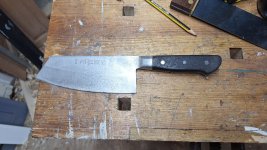
knife.jpg I take good care of it. I do.

But someone, (not me but there are only two of us here...) put it in the dishwasher.
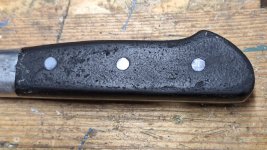
handle 1.jpg
handle 2.jpg

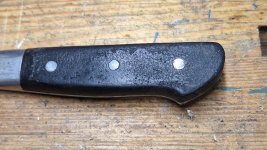
The blade appears to be unscathed, but the handle is corroded. I don't know what it is made of, some sort of resin, I guess, but it has come out a funny grey/green colour and pitted. I tried sanding off the grey/green, but that made it worse, the black is just on the surface. I've tried to restore the colour a bit with a black dye:

black dye.jpg

IIRC it is a spirit stain for leather, so not ideal. I bought it about a century ago. It is also rather blue-black rather than true black. Better than nothing but not great.

Does anyone have any bright ideas about how I can get this back to its former glory? The only other black finishes I have are aerosol paints, one for radiators and the other Chestnut Ebonising lacquer, also about a century old.

Any help most very gratefully received.

S
 
I think it's time to rip the rest of the resin off and use up that little bit of rosewood/ebony/hornbeam that you've been saving for something special. I'd send you a bit if you don't have any, but I don't think it would get through customs. 🙁
 
Thanks for that, Andy.
And no, I don't think it would get through customs. Even small items attract VAT and customs duties now and raw wood would have to have a phyto certificate. Samsung sent an empty cardboard box to my niece-in-law for her to send in her phone and she had to pay some inordinate amount of money to receive it. It's ridiculous.

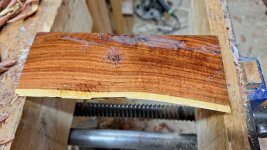
I don't have any rosewood/hornbeam. I did have a bit of ebony and African blackwood, but I gave my box of maybe-useful-one-day exotics away when I moved. I do have some bog oak, but it's a bit coarse for this, I think. I also have some bubinga and a bit of cocobolo, which I'm not sure would be big enough, I'll have to find it and check.

One option I have been thinking about, while trying to calm down, dear, is to find some black powder (we have a wood-burner, so maybe I can find some soot), mix it with epoxy and fill the surface. Take it from there.
S
 
I totally agree with wot @AndyT mentioned above; rip off the now ghastly original scales (correct term??) and replace with something a bit posher. Araldite (proper 'old skool' stuff) them in place and clean up. I've got plenty of Bubinga etc offcuts and you're welcome to a bit, but I don't fancy paying an arm and leg to get it to 'la belle France' - Rob
 
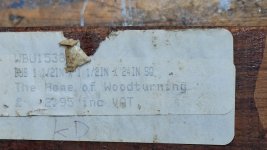
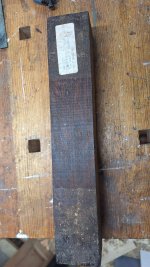
I've found my cocobolo and it is more than big enough. It's labelled "Home of Woodturning - Part seasoned", so a) it gives you some idea of how old it is (Craft Supplies hasn't been around for decades) and b) I should think it's now as seasoned as it's ever likely to get.

I don't have any rivet material, but I've found a place online where I can get 200mm of 5mm and 200mm of 6mm brass rod for 8€40 delivered, which seems extraordinary. The original rivets are some kind of steel (stainless or silver, I don't know how to tell) but I think brass would look OK. I think that buying both 5mm and 6mm is a good idea, because I can see me drilling out the originals (5mm visible, but I guess they could be 4mm and countersunk to 5mm) and ending up with a bigger hole than I intended.
S
 
I spoke to soon. "Delivery" is free only if I collect it from their store, 300km away...
Otherwise delivery is more than the goods. I'll see what I can get the next time I go to Leroy or Brico. Pity, I was at Brico only yesterday.
S
 
I am a lifelong kitchen knife nerd. Unusual to see a Nakiri with such a curved blade. Looks like a stainless steel stamped knife for export. Can't make out the Kanji as the photo is not clear on my laptop. Easy enough job to pop the scales off the western blade and add new ones with new rivets or knife studs. I wouldn't mess around trying to fix that resin impregnated handle. Most traditional (Wa) style Japanese knives used Honoki (Magnolia) or Cherry or Chestnut. Cherry dyes black very well. Magnolia is very water resistant. Works equally well on western style handles.

A lot of functional Japanese knives that are not using premium woods (Wenge, Ebony etc) use chestnut that they blacken (yakisugi) in the same way that has ben popularising in the west recently (shou sugi ban we call it over here). Blowtorch and then oil it. That would look good and high end.

Good luck. Looks like the edge needs a touch up :cool:

Final thought - do you have a polishing mop and compound? Might be worth trying that. My wife knows divorce is certain if she puts my hand made knives in the dishwasher. So she will do that one day when she wants rid of me!
 
The knife came from a company in Lewes which specialises in Japanese imports. It was 20-odd years ago, so I don't know if they are still going. I showed it to a Japanese friend once and she said that the writing was the name of the man who made it.
I don't know where the policy engineering company is, but there is bound to be somewhere in Bellac.
 
The knife came from a company in Lewes which specialises in Japanese imports. It was 20-odd years ago, so I don't know if they are still going. I showed it to a Japanese friend once and she said that the writing was the name of the man who made it.
I don't know where the policy engineering company is, but there is bound to be somewhere in Bellac.
Asked Google AI and it came back with this for 5 & 6 mm brass rod - doesn't mean anything to me Steve but hopefully may help you 😀
You can buy a 6mm solid brass rod locally via Bricomarché Bellac (which stocks items like the Alfer 6mm solid brass round rod), but finding a 5mm rod locally in the small town of Bellac is difficult. [1, 2]

Local Options in Bellac
    • Bricomarché Bellac (D49A, 87300 Bellac): Stocks general hardware and specific metal profiles including 1-meter solid brass rods in select sizes (such as 6mm), though smaller or intermediate diameters like 5mm may need to be special-ordered or might not be on the shelf. [1, 2]
    • Local Hardware / Quincaillerie: Regional hardware suppliers nearby like Thimonnier SA in neighboring Blanzac (about 3 km away) carry broader rural and domestic hardware supplies, but specialized non-ferrous metric rod stock in exact 5mm increments is rarely stocked comprehensively in small-town French hardware outlets. [1]

Alternative Sourcing Online & Regionally
    • Online Metal Retailers: Websites specializing in hobbyist and engineering materials ship across France with short delivery times.
    • Larger DIY Warehouses (Brico depots / Leroy Merlin): Driving toward larger regional commercial hubs (such as Limoges) will grant access to big-box home improvement centers like Leroy Merlin, which carry much larger metal profile selections in-store.
 
I would be taking the easy way out and dye some casting epoxy and then dip/paint the handle. Hang it to cure, repeat if necessary and then sand and polish it you like. Tie a rope to it, anchoring it to the cutting board, to keep it out of the dishwasher.

Pete
 
There is no reason why the rivets need to be 5mm Steve. For example Kramer knives which go for $thousands ++ use a larger embossed central rivet. You can buy online special bolts which knife collectors use if they wish to interchange scales. Personally I think brass rivets look odd with a stainless steel blade. You can also bond scales on very effectively, or (with a fair bit of work) convert to a Wa handle.

If you want to send me the knife (UK) I will put a couple of scales on for you in Wenge or something else exotic, and polish and sharpen the blade. Gratis as you have been such a helpful bloke on the forum over the years.

Adrian

If you zap me a clear photo of the Kanji I will translate it for you. It will most likely be a factory rather than an individual knife maker. Very few artisan Japanese knives are made in stainless steel. Most are Hitachi 1 or 2 blue paper carbon steel if artisan made. Even many small artisan workshops buy in stamped blanks over the past 30 years. Hand made is serious Yen.
 
You are all being very helpful, thank you.

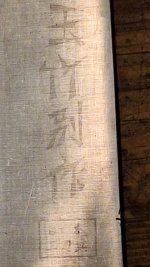
Adrian, that is most very generous of you, and if I were planning a trip to the UK any time soon, I'd certainly take you up on it. I tend to agree that brass rivets on steel handles look a bit odd. Here is a (slightly) better shot of the Kanji (all these have been taken with my phone, and the colours are not well represented. All my proper camera gear is packed away).

kanji.jpg

It probably translates to "The ACME Knife Company for Gullible Westerners". It was a present from my ex-MIL, and while she was a generous old bird, she would not have been thousands generous.

I've been on a rummage and I have discovered that I have several different pieces of bubinga.
bubinga 1.jpg

bubinga 2.jpg20260927_182440.jpg

Some are labelled as such others are unlabelled but look similar.

unlabelled 1.jpg

unlabelled 2.jpg

20260927_182359.jpg


This is darker than the others.

But the piece that I fancy the most is this:raspberry jam 1.jpg

There is no label on it, but I seem to remember it being sold as Raspbery Jam wood. Again, the camera does not do the colour justice.

I've also found some 8mm brass rod (it looks rather too big to me) and some 4.5mm steel rod. I don't know what sort of steel but it is sitting in the barn and not getting rusty but it is magnetic, so I don't know what to make of that.

I think the first step is to remove the resin scales and see what I am dealing with.
S
 
Last edited:
As Pete has said, the barn steel is likely to be stainless. There are two common families of stainless steel: 300 series and 400 series. 400 series is magnetic. Alternatively, the steel could be plated in something. Or of course, your barn might be completely free of any moisture :)
 
EBay. Corby bolts. They create a good mechanical fixing, without relying on glue or the risk of peening rivets in wood. Sometimes when you get the handle off you may find the holes in the tang are a fair bit smaller than the original rivet head, which suits Corby bolts well without needing to drill out the holes so much. I used some on this knife, which is a smaller 4" cooks knife, from a Sheffield maker (Richardson ?) - the black resin scales shrunk and cracked, even without the dishwasher. I used some wild plum for the scales. The bolts are available in brass or something looking silver - I don't know what it is but as you file it down to flush, I imagine it will be an alloy softer than stainless. Or it will be hard work.


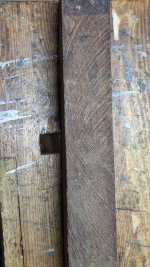
I've found some more exotics in my pile. Some genuine ebony, given to me by Reg Slack. It's very cracked and split, but one day it will make some nice small knobs. Also a nice piece of Madagascar Ebony. But having planed up a few faces to see better what I had I think I'm going with the cocobolo. These are all sloshed with thinners:

Bubinga (think Veritas)

bubinga finish.jpg

The raspberry jam. It's a bit ornery.
jam finish.jpg

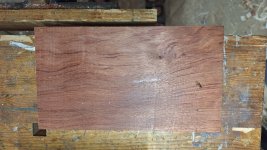
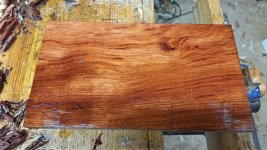
But look at this cocbolo
cocobolo finish.jpg

I'm going to use the cocobolo.
S
 
Steve, that is a factory knife made for export in Osaka. The kanji is etched (on hand made knives it is always chisel stamped or dot stamped) and says "special production" (code for export market) "made by Tōryū workshop". There were a few workshops with that generic name, but the most likely for export is Osaka or possibly a smallish factory that at least used to use a similar name just outside Tokyo. It will be a stamped blade (nothing wrong with that) and the handle was most likely fitted in a different workshop.

The reason I don't think it is a Tokyo knife is practically all production there is for the Tokyo tourist market. It would not typically be bought by a Japanese cook as there is much too much curve on the blade. It's a vegetable knife intended for the rock chopping method. Most Japanese prefer a slicing motion, so Japanese nikiris usually have a straight blade and all of mine are also single bevel.

When restoring it I would be tempted to polish the blade.
 
Ah well, seems like I've been in a bit of a Japanese dream-all these years. But thank you anyway. And it also explains all this:

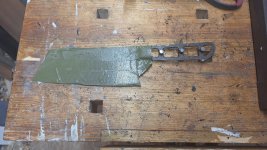
The first thing I did was to wrap all the steel in a couple of layers of gaffer tape and then sharpen an old chisel to within an inch of its life. I'm glad I used an old chisel and not one of my good ones, as within just a few blows of the mallet I had lost a couple of very significant chips from the edge. I wish I'd taken a pic, but I just got back onto the grinding wheel.

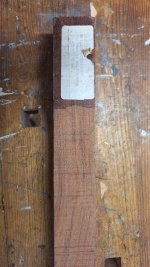
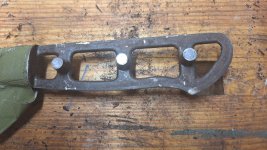
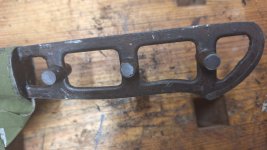
The resin was quite tenacious but it did all come off, eventually and this is what I was met with.

20260928_153632.jpg

20260928_153637.jpg

20260928_153654.jpg

Those "rivets" are, in fact, studs, cast as part of the blank. So I think they will have to be ground off and drilled out.

Regarding the shape of the handle - obviously the profile is set by the blank, but what about making the handle a bit fatter at the heel than it is at the shoulder?

There's no going back now, is there?
S
 
Could you place one of your wood blanks on top of the knife and whack it with a persuading stick? That would probably make some nice little dents in the wood in just the right place for the holes and you could drill them out of the wood and then use the existing pins.

I'd be tempted to try on some soft wood (for a nice clear dent) and see how well it fits. If it fits well you could use the soft wood piece as a template.
 
Steve, did you check where the balance point of the knife is before you took the scales off? It should be at or just behind the bolster for an evenly balanced knife. I presume the resin went right through the holes in the handle blank? If so and you replace with scales it will change the balance of the blade and make it blade heavy.

I agree with Al. I wouldn't grind the studs off at this point. I can't see it will help much if you are going to epoxy scales on.
 
Grind them flush and epoxy the scales on, then grind to a comfortable shape.

Add some steel in the gaps in the frame to adjust the balance.

Pete
 
So there are two approaches, drill the scales to match the pegs somehow, or grind them off possibly drilling for new rivets/Corby bolts. I personally doubt my ability to drill wooden scales to match the spacing of those pegs with an accuracy I would be content with, so my leaning is to grind them off, drill for Corby bolts, and use in conjunction with old school slow epoxy to fill the voids - if the wood is fairly dense and the voids are full of resin I doubt the balance will be too bad. Somehow a chef's knife with just glued scales but without the rivets wouldn't look quite right ?
 
Somehow a chef's knife with just glued scales but without the rivets wouldn't look quite right ?
Most if not all Japanese chef's knives use a ferrule of some sort (usually horn) with a wooden handle then tapped onto the tang. Many use Magnolia but it really depends on which firm or artisan made them; I have a small veggie knife with a Walnut handle. The rivet thing is used on Western blades and I've never seen a Japanese chef use one - Rob
 
Back
Top