

Mike G
Petrified Pine
I've been hinting at this for a while, but things are now just getting under way. I am going to be building something along these lines:

This isn't met with unbridled enthusiasm by my wife, but she understands that the alternative was a boat. This is the lesser of two evils for her, and our motivation is that we can use it to cycle, walk and paddle in new areas at short notice.
The strategy is to build everything from scratch, including the chassis......but the chassis will be delegated to a local fabricator. Everything else will be by me. One of the deeply frustrating things in the design process has been the lack of accurate information. I have been ordering stuff "blind". There are a couple of critical dimensions I need for the chassis design, and one of those was the space needed for the bikes to sit on the "tongue" (triangular frame at the front of the trailer). So, I bought a couple of roofrack bike stands from Facebook Market-place, and rigged up something temporary to check on the minimum spacing:


DaveL of this parish printed me some plastic knobs for those stands. I took the necessary measurements and adjusted the tongue length to suit. The far bigger frustration was not knowing the ride height of the chassis with my chosen wheels, tyres and suspension units. In the end, I just had to buy the stuff and measure it for myself.
So, decision one.......15" wheels. I came to this not only from looking at my drawing, but also from measuring a friend's teardrop which I've had here for a week or two for some repairs and alterations. After liasing carefully with the company supplying all the trailer bits-and-pieces (suspension units, hitch, jockey wheel, corner stands, lights etc), this package turned up:

.........and was then fitted with a pair of 215/65 R15s (it turns out that's a standard size for vans such as Transits, so these are 8 ply tyres):

I then went to order all the stuff I just mentioned, and found out that the only hubs which would fit my wheels either had to be specially made, or had to be braked, which I don't need. For the sake of speed, I opted for the braked hubs, but empty of all brake components. A package of goodies turned up a couple of weeks later:

The guy at the trailer parts supplier had estimated the clearance between the inside wall of a tyre to the plate of the suspension unit at 35mm, and I could now measure to find out the accurate figure. Luckily, he was close, as it came to 39 or 40mm. This is a critical figure because the side walls of my caravan come down outside the chassis, and I need to organise for there to be enough clearance.
Now, to measure the chassis ride-height, I decided on an experiment. I decided to bolt the suspension units and wheels onto a board, and load it up. It was actually pretty straight-forward. I coach-screwed the units onto a pair of scaffold boards:


At this point I took a baseline measurement (mark on a stick). I then loaded up the planks with 50 bricks:

The design weight of my trailer is 650kgs, so, after I weighed a brick (I actually weighed 5 different bricks and took the average):

.....and measuring the deflection:

I was able to do some simple arithmatic and come up an estimate of the chassis height under a full load:

I will play with my drawing tomorrow, but I suspect that this will mean the suspension units will be packed down below the chassis. This is no problem.
I won't be producing the detailed drawings you're all used to for this build. There are quite a number of innovations in my design which will just be stolen/ copied immediately by others. Teardrops are actually quite a big thing in the USA, and although they are really badly built these things can cost an awful lot of money. I'm not planning on helping them out! However, I can let you see a plan of the 2.7 x 1.5m chassis:

You can see the bike rack on the front, and the framing for a "well" above the axle location. This is for a water tank and battery compartment. The big innovation in that drawing, though, are the plates with multiple holes, giving 4 locations for the suspension units. The big deal in trailer (and caravan) safety is having them properly balanced, with the optimum tongue weight (weight on the hitch). As I have never built one of these campers before, I can't be certain where the balance point should ideally be. The front compartment is just a bed, so is very light. The rear holds a kitchen, stacked with fridge, cooker, food, cooking stuff etc, so is comparatively heavy despite being small. Having the ability to move the axles backwards or forwards, in addition to being able to move the battery/ ies in the big well, gives me the best possible chance of getting this thing properly balanced.
Finally......what's it going to look like? Well, I am going to build it in the manner of a (western red-cedar) strip-built canoe:

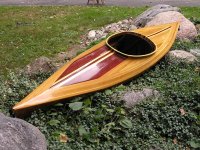
......and it will be framed and detailed with bog oak. As with canoes, it will be fibreglassed and varnished.
So, that's it for now. The next progress to report will be when the chassis comes back from the fabricator. The basic timetable is to get the shell fibreglassed before the autumn gets too much underway, as fibreglassing is temperature and humidity dependant.
This isn't met with unbridled enthusiasm by my wife, but she understands that the alternative was a boat. This is the lesser of two evils for her, and our motivation is that we can use it to cycle, walk and paddle in new areas at short notice.
The strategy is to build everything from scratch, including the chassis......but the chassis will be delegated to a local fabricator. Everything else will be by me. One of the deeply frustrating things in the design process has been the lack of accurate information. I have been ordering stuff "blind". There are a couple of critical dimensions I need for the chassis design, and one of those was the space needed for the bikes to sit on the "tongue" (triangular frame at the front of the trailer). So, I bought a couple of roofrack bike stands from Facebook Market-place, and rigged up something temporary to check on the minimum spacing:
DaveL of this parish printed me some plastic knobs for those stands. I took the necessary measurements and adjusted the tongue length to suit. The far bigger frustration was not knowing the ride height of the chassis with my chosen wheels, tyres and suspension units. In the end, I just had to buy the stuff and measure it for myself.
So, decision one.......15" wheels. I came to this not only from looking at my drawing, but also from measuring a friend's teardrop which I've had here for a week or two for some repairs and alterations. After liasing carefully with the company supplying all the trailer bits-and-pieces (suspension units, hitch, jockey wheel, corner stands, lights etc), this package turned up:
.........and was then fitted with a pair of 215/65 R15s (it turns out that's a standard size for vans such as Transits, so these are 8 ply tyres):
I then went to order all the stuff I just mentioned, and found out that the only hubs which would fit my wheels either had to be specially made, or had to be braked, which I don't need. For the sake of speed, I opted for the braked hubs, but empty of all brake components. A package of goodies turned up a couple of weeks later:
The guy at the trailer parts supplier had estimated the clearance between the inside wall of a tyre to the plate of the suspension unit at 35mm, and I could now measure to find out the accurate figure. Luckily, he was close, as it came to 39 or 40mm. This is a critical figure because the side walls of my caravan come down outside the chassis, and I need to organise for there to be enough clearance.
Now, to measure the chassis ride-height, I decided on an experiment. I decided to bolt the suspension units and wheels onto a board, and load it up. It was actually pretty straight-forward. I coach-screwed the units onto a pair of scaffold boards:
At this point I took a baseline measurement (mark on a stick). I then loaded up the planks with 50 bricks:
The design weight of my trailer is 650kgs, so, after I weighed a brick (I actually weighed 5 different bricks and took the average):
.....and measuring the deflection:
I was able to do some simple arithmatic and come up an estimate of the chassis height under a full load:
I will play with my drawing tomorrow, but I suspect that this will mean the suspension units will be packed down below the chassis. This is no problem.
I won't be producing the detailed drawings you're all used to for this build. There are quite a number of innovations in my design which will just be stolen/ copied immediately by others. Teardrops are actually quite a big thing in the USA, and although they are really badly built these things can cost an awful lot of money. I'm not planning on helping them out! However, I can let you see a plan of the 2.7 x 1.5m chassis:
You can see the bike rack on the front, and the framing for a "well" above the axle location. This is for a water tank and battery compartment. The big innovation in that drawing, though, are the plates with multiple holes, giving 4 locations for the suspension units. The big deal in trailer (and caravan) safety is having them properly balanced, with the optimum tongue weight (weight on the hitch). As I have never built one of these campers before, I can't be certain where the balance point should ideally be. The front compartment is just a bed, so is very light. The rear holds a kitchen, stacked with fridge, cooker, food, cooking stuff etc, so is comparatively heavy despite being small. Having the ability to move the axles backwards or forwards, in addition to being able to move the battery/ ies in the big well, gives me the best possible chance of getting this thing properly balanced.
Finally......what's it going to look like? Well, I am going to build it in the manner of a (western red-cedar) strip-built canoe:
......and it will be framed and detailed with bog oak. As with canoes, it will be fibreglassed and varnished.
So, that's it for now. The next progress to report will be when the chassis comes back from the fabricator. The basic timetable is to get the shell fibreglassed before the autumn gets too much underway, as fibreglassing is temperature and humidity dependant.
Last edited:


