• Hi all and welcome to TheWoodHaven2 brought into the 21st Century, kicking and screaming! We all have Alasdair to thank for the vast bulk of the heavy lifting to get us here, no more so than me because he's taken away a huge burden of responsibility from my shoulders and brought us to this new shiny home, with all your previous content (hopefully) still intact! Please peruse and feed back. There is still plenty to do, like changing the colour scheme, adding the banner graphic, tweaking the odd setting here and there so I have added a new thread in the 'Technical Issues, Bugs and Feature Requests' forum for you to add any issues you find, any missing settings or just anything you'd like to see added/removed from the feature set that Xenforo offers. We will get to everything over the coming weeks so please be patient, but add anything at all to the thread I mention above and we promise to get to them over the next few days/weeks/months. In the meantime, please enjoy!
My first digital infrared photograph

Andy Kev.

Nordic Pine
Joined
Jan 4, 2021
Messages
722
Reaction score
59
Apr 22 Sch Orchard 1.jpg

You may remember a bit of a discussion about B&W digital photography from a couple of weeks ago. I discovered that my new camera can do IR phots so had a bash. Here is the first photo which I was pleased with. IR is probably a bit marmite so I will understand if you don't like it at all. It's of an orchard and I took it on Easter Sunday. I've got a feeling it will look a bit better when I've had it printed up, say to about 18" wide.
 
Nothing as complicated as that. You simply screw an IR filter onto the front of your lens. I used a 715 nm filter. It's all about cutting visible light out as opposed to doing anything active with IR.

The rest of it is down to your sensor or film. Can the sensor register IR? If yes, screw on the filter and away you go. For film cameras you have to buy IR film or semi-IR film and the necessary filter. With a digital camera you can up the ISO rating to whatever you want but with a film camera there will definitely be long exposure times. IMO a tripod is advisable in both cases.

I think I did that pic at 1/60 sec so I used a tripod.
 
I don’t dislike it Andy. I'm left wondering though what a B&W image of the same scene would look like.
 
Been there done that many years ago. So long ago in fact it was my first digital camera a Kodak DC290.

If your camera can see the led light up on a conventional TV remote when you press the button then it will do IR. Some are better than others at IR. If you are dedicated enough and have the right camera you can remove the filter from the cameras sensor and have a dedicated IR sensitive camera.

The pictures are shades of red as I remember it and you have to process them into black and white. The relative brightness of different colours under IR is what makes the pictures more interesting than standard monochrome. The novelty soon wore off for me :)

Nice perspective in your shot and it is sharp too. Mine were only sharp sometimes.
 
Andyp":3l9fd8f9 said:
I don’t dislike it Andy. I'm left wondering though what a B&W image of the same scene would look like.

Thanks.

Normal B & W would have the leaves of the trees and the grass as mid greys, and the tree trunks would probably have been paler than in this pic. FWIW I don't think that orchard was a suitable subject for a normal B & W photograph. In colour it would have been quite pretty but it would also have been the kind of picture that you've seen a thousand times before.
 
Interesting.

I find myself wondering what subjects would be perfect for IR and produce a more interesting image than the same subject with a colour or monochrome approach? The obvious ones are wildlife at night, but although that reveals activity, I have yet to see an IR image of wildlife that I would want to frame. Happy to have my mind opened on the subject though. No idea if my cameras (Canon full frame digital) will do IR.
 
As a slight digression, when colour TV was in its infancy, the BBC ran short training courses for set designers and costume designers. The emphasis was on compatibility between what those watching monochrome TV's would see vs. those watching on a colour TV.

There was one particular set and costume example that the lecturers loved to show. Really vibrant full-on colours. The course participants were ecstatic. Colour TV was so 'new'. These looked stunning.

"Let's see what the monochrome viewer sees, shall we?" asked the lecturer switching the colour off.

Gasps from the course participants as a uniformly grey screen with zero detail was shown.
 
Ted Lowe, I think, snooker commentator..
“For anyone watching in black and white, the pink is next to the yellow”
 
If you have an old film camera, focus as normal, then look at the lens barrel. On the top, there are two diamonds or triangles opposite the distance scale. the one you are on (at t.d.c. usually) is for visual wavelengths. The wee red or yellow triangle or diamond slightly to one side is the infra-red focus point. Just move your focus ring, so that the previous distance reading on visual is now on the I.R. point. Click shutter.

It helps to use a small aperture, as the depth of field thereby is more forgiving of slight focus errors than at, say, f2.8.
 
AJB Temple":31j75bx6 said:
Interesting.

I find myself wondering what subjects would be perfect for IR and produce a more interesting image than the same subject with a colour or monochrome approach? The obvious ones are wildlife at night, but although that reveals activity, I have yet to see an IR image of wildlife that I would want to frame. Happy to have my mind opened on the subject though. No idea if my cameras (Canon full frame digital) will do IR.
Adrian, you have a talent for asking questions that require thought-out answers.

The most straightforward answer IMO is that you have to develop your own aesthetic. However, that sounds ridiculously pompous. FWIW the guidelines which I've arrived at are:

a. Show the natural world in all its glorious colour but keep an eye out for composition (rule of thirds etc.) and for unusual positioning.

b. B&W demands structure which strikes the eye in some way. The late Robert Mapplethorpe made his name doing B&W pics of flowers. People thought he was nuts when he started but he had identified the structural beauty of some flowers. In my view though, he was not giving the complete picture because flowers depend on colour for their function. That sad, in artistic terms he was bang on.

c. IR can be B&W+. It would however be easy to overdo it. To many pictures of e.g. orchards where the IR effect is predominant would soon become tedious. What IR does do IMO is take you almost straight to the finished image.

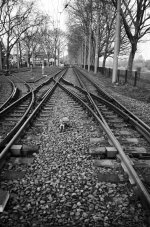
I'll see if I can illustrate what I'm on about in 3 pics. The first is a tramline and it is unprocessed i.e. as it came out of the camera. There's a bit of structure there although it didn't make my personal cut. I actually think it's a bit of a naff pic but that makes it useful to make the point. It's worth clicking on each pic to be able to judge it better.

Tram (undev).jpg

Because I got in a bit of a muddle, the tweaked version, to get a bit more out of it, is at the bottom of the post


Here's an IR shot straight from the camera. I probably would tweak it a bit to get the most out of it but in a good shot (which IMO this isn't) that wouldn't be necessary.

Poplars.jpg
 

Attachments

  • Tram (dev).jpg
    Tram (dev).jpg
    350.4 KB · Views: 1,041
I shot a couple of rolls of IR film in the 1970’s, I still have the filter somewhere. I wasn’t overly impressed at the time. Some photographers have their digital cameras modified for IR photography. Photo software can emulate IR without going to that extreme though. I’m sure IR enthusiasts can see the difference but for the rest of us, maybe not?

https://www.shutterbug.com/content/infr ... ion-shoot-“normal”-process-ir
 
Back
Top