• Hi all and welcome to TheWoodHaven2 brought into the 21st Century, kicking and screaming! We all have Alasdair to thank for the vast bulk of the heavy lifting to get us here, no more so than me because he's taken away a huge burden of responsibility from my shoulders and brought us to this new shiny home, with all your previous content (hopefully) still intact! Please peruse and feed back. There is still plenty to do, like changing the colour scheme, adding the banner graphic, tweaking the odd setting here and there so I have added a new thread in the 'Technical Issues, Bugs and Feature Requests' forum for you to add any issues you find, any missing settings or just anything you'd like to see added/removed from the feature set that Xenforo offers. We will get to everything over the coming weeks so please be patient, but add anything at all to the thread I mention above and we promise to get to them over the next few days/weeks/months. In the meantime, please enjoy!

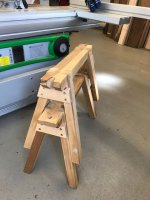
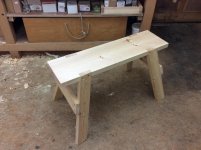
New step up/ sawhorse, swine of a joint.

Cabinetman

Sequoia
Joined
Oct 11, 2020
Messages
5,764
Reaction score
1,433
Location
Lincolnshire Wolds + Massachusetts
Name
Ian
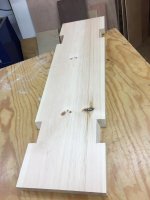
So after 20 years of hard use my old ones finally gave up the ghost, and after 20 years I had forgotten what a problem I had with the joints last time. This is one of a pair, just finished. Some will say that they’re not very good for sawing on as the legs stick out and get in the way, you have a point, but you soon get used to not sawing the legs off! And they are so useful for stepping up onto for decorating and 101 other things.
28D07B5E-D3AC-412B-8F78-A8CF910BCA8C.jpeg
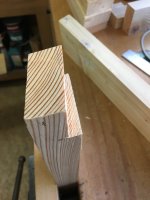
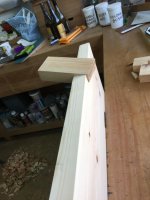
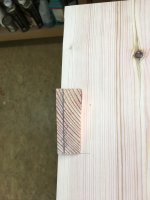
If the legs just came straight down with one angle involved it would be easy but as soon as you want the legs to angle in two directions ( backwards and outwards) there is a twist naturally happens which you have to work around, how you work out the funny angle (Best seen on the top photo) which you can see here, is as far as I can tell trial and error.
I know one or two of you will say, no they just go straight in, well it seems obvious until you actually try it! Ian
6C2E6866-22F8-44AB-87F8-D8FA9EBEDA8B.jpeg
CB870CB3-4B0D-4F5F-8697-43B8A6DCE669.jpeg
 
Yeah, that one's a bundle of fun, Ian! I've known this to be a test for job applicants....."you've got an hour to make a pair of saw horses with splayed legs. Here's a pile of off-cuts....GO!"

The secret is to make the legs in pairs, and screw the board across them (the little board at right angles to the top). Then, you need to screw temporary battens across the outside of the legs, so all four legs are standing in the right position, but with the top nowhere in sight. Then a spirit level, believe it or not, gives you the line for the adjustment to the inside face of the top of the legs, giving you a vertical face for the join into the top. It also marks out the longitudinal line on the tops of the legs. The adjustment for the skewing of the legs is done on the inside of the legs, not the outside, and, the face of the joint between the back of the leg and the top board is vertical. That's the key.

After that, offering the top up and getting a mark for the joints is a piece of cake. To aid this, though, I suggest having the little end cross-boards hard up to the underside of the top, and I'd certainly make it out of wider stock than you've used. Get the sizing, shape, and location of those end boards right and they enable the horses to stack.
 
Now you tell me!
Thanks you two, but I shan’t be making any more now, these will definitely see me out. Lol
The funny thing is when you imagine it in your minds eye there shouldn’t be a problem at all.
 
I seem to recollect in one of the Haywood books, the 'master' lays out exact details and drawings on how to make a pair of splayed leg sawhorses, but quite which book :eusa-think: - Rob
 
Thanks Nick M. I think we had better get the "Masters" instructions as well as Mikes above on how to make one properly! I just set to thinking it couldn’t be that difficult (forgetting what a begger it was last time 20 years ago) it seems obvious to start with the angled sloping housings in the top, but obviously not! Mine have worked out okay and will be good for another 20 years but obviously just not the easiest way to do them. Ian
 
NickM":uab9lur3 said:
Saw horses are on my to do list. Yours look very good.

Have a look at my alternative type, below, before you decide. They are easier to make and the legs don't get in the way so much. The splayed leg ones are better on a building site with rough ground, but if you work somewhere with a flat floor, this type are great.

https://thewoodhaven2.co.uk/viewtopic.php?f=26&t=4193
 
The advantage(s) of the traditional splayed leg sawhorse is that they''re then easy to stack one on top of another as well as giving a more stable platform for sawing - Rob

Edit - there are basic sizes in Joyce's TTOFM, page 58, but no details on joint layout etc
 
We made one as an apprentice at college 42 years ago. I still have it and have been thinking about taking it apart to get all the joint angles so that I can make a new one.
 
Mike G":2ojhganj said:
NickM":2ojhganj said:
Saw horses are on my to do list. Yours look very good.

Have a look at my alternative type, below, before you decide. They are easier to make and the legs don't get in the way so much. The splayed leg ones are better on a building site with rough ground, but if you work somewhere with a flat floor, this type are great.

https://thewoodhaven2.co.uk/viewtopic.php?f=26&t=4193

I like the look of yours Mike, but my workshop floor is definitely not flat so I need to take that into consideration.
 
I think there’s a Paul Sellers video on how to make the splayed leg version which I think explains how to lay out the joints.
 
Thanks Andy, but I think that’s even more frightening than Rogers staircase 3-D projected diagram lol.
Makes me wonder how on earth I managed to do it by making it up as I went along even though the legs on mine are set at a slight angle, but looking at them I find that quite pleasing to look at, which is just as well as I’m not changing them now haha, and they are really strong, with the legs being splayed in three different angles relative to the top it might actually give me a bit more rigidity/stability? Ian
 
Sawhorses with a double splay just sort of look "right", so that's generally how I make 'em!

Saw-Horses-01.jpg

Saw-Horses-02.jpg

They take a bit more time in the setting out, but once the layout work is done they're fairly quick to make. I can make two pairs in a day and I'm sure any traditional joiner would have been able to knock that into a cocked hat!

If I'm using them at my local boatyard/marina then I'll often get enquiries about where to buy them, I sometimes think I should set a few days aside and batch out a load...can't see how it could possibly be less profitable than custom furniture!
 
Ah, the old classic! Surely every college-taught Carpenter/Joiner across the land has made one of these!

If I remember rightly, the way we were taught to do them was with an angle of a 1:4 ratio, you got this by marking a square line relative to the edge of your bench on the top (or on a piece of scrap, alternatively) and making a mark four inches up, an inch to the left or right of the line at the edge of the bench and connecting the two points with your sliding bevel to obtain the correct angle.

I'd say that I would knock out a test joint to see if I can remember how to do it, but I never got around to doing AndyT/Custards O-Level Woodworking Exam Challenge that also had handwork :oops:

I wonder if there's a way I could cut it with the spindle moulder :eusa-think:
 
Trevanion":1bwjcj52 said:
O-Level Woodworking Exam Challenge

You make an interesting point.

Somewhere I've got a few O-Level Woodwork exam papers. I can't recall if a double splayed leg joint was ever included, but it wouldn't surprise me if it was.

The sobering thing is that the O-Level woodwork exam was actually pretty challenging, especially as it was done against the clock. Yet we tend to use the expression "O-Level" in a disparaging sort of way, as if it was too trivial to be taken seriously. Maybe it's a measure of how hand skills have declined, but it's staggering that only a generation ago that level of accomplishment was considered appropriate for fourteen and fifteen year olds.
 
I haven't watched the video in a while (I posted it early in this thread) but I think Robin Clevitt knocks these double splay trestles out in about 20 minutes each. Not as nice and refined as Custard's mind you :D

Frankly Gary, if Rob Cosmann (and others I now find) can sell a shooting board for £180, really nice trestles like that should fetch good money.
 
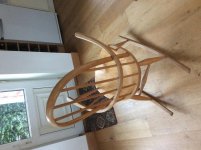
Crikey, I had forgotten the time challenge o level joint, it was a long time ago and I might be mixing it up with the A level one but it definitely wasn’t one of these, I still have my A level project, a Windsor rocking chair, I just drew it up to how I thought it should sit, but in reality I was just very lucky that it "worked", quite comfortable really. I tried steam bending kiln dried Ash? Silly boy! Then ended up laminating the back, arms and rockers, I was really pushing my luck as I had both the back and arm hoops in single pieces, and also had the arm hoop intersecting with the turned back rods, I must have been mad! But It worked. Take a picture in the morning. Ian
6BD6597B-FE35-45B1-A15B-952864C02916.jpeg
 
Sorry the photo is not right, well that was nearly half a century ago when I was 17/18. I think it’s true what Custard said, I can’t see many boys of that age doing anything like that nowadays.
How on earth I got away with the back and the arms and the slats lining up like that I really don’t know. Ian
 
Cabinetman":17imi8qz said:
....... How on earth I got away with the back and the arms and the slats lining up like that I really don’t know. Ian

It looks like the arms were added last, with the back already in place, so you might have been able to take a pattern from them and design your formwork to suit.
 
AndyT":1c8j0dk1 said:
Picking up on mentions of the O-level challenge, the whole story is here, with my own and some others' attempts. It's on another forum but anyone can read it.

I'd love to see some more of us get round to trying it!

https://www.ukworkshop.co.uk/threads/o- ... ge.123820/

I am going to have a go at this shortly. I have a hiatus between projects on the horizon, so I'm going to revisit it.
 
You’re probably correct Mike, it was a long time ago, I had forgotten that the shape of the arms changes from A vertical oblong in the centre of the back to horizontal oblongs at the ends of the arms, nice touch young Ian.
That O-level exam looks pretty much like the one I did in 1972 I think it was, that was an interesting test you gave them Tony, I suspect most boys results were not quite as clean as your adults but then I wouldn’t expect them to be.
 
AndyT":3pjg45r1 said:
Picking up on mentions of the O-level challenge, the whole story is here, with my own and some others' attempts. It's on another forum but anyone can read it.

I'd love to see some more of us get round to trying it!

https://www.ukworkshop.co.uk/threads/o- ... ge.123820/

Never having studied woodwork at school (and in fact never having done any real woodwork before about a year ago), I quite fancy a go at this once my current project is complete. I might have to use oak as I don't have much else, but maybe I'll manage a trip to a wood shop once lockdown eases a little. I might also ignore the time deadline as I'm more interested in whether I can make things well than whether I can make things quickly.

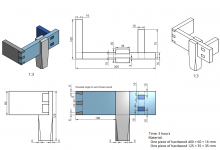
Just for fun, I thought I'd redraw the drawing in less antediluvian units (and in 3rd angle projection, which I prefer to the 1st angle projection used in the original drawing). If anyone else is interested, here it is:

WoodworkOLevelDwg.png

3D CAD model is here for those who are really keen!
 
Top notch drawing Dr Al.

I did this challenge when it was elsewhere. It's straightforward enough for anyone used to doing dovetails etc anyway, but you need to crack on to meet the time.

Still remember my woodwork at school. Also metalwork. I really enjoyed both and the teachers were brilliant. I still have things I made in both classes and after school sessions. Unfortunately I was not allowed to do O levels in either of them so had to stop at 14 as I was very academic and was made to do things the school thought more useful to my likely career. (At A level I did pure maths, applied maths and further maths along with a couple of other things, so that gives you an idea of what the school thought was useful. :D ). It is actually a mistake IMO stopping kids doing practical subjects, even if they are academic children. I think they should all be taught to cook as well.
 
Good to see a resurgence of interest in this little challenge! The more the merrier.

Adrian, I thoroughly agree with your comment there. My experience was similar - I enjoyed my brief introduction to wood and metalwork and asked to take the O-level. But it was allegedly "impossible to timetable" for anyone already taking physics, chemistry, and biology. There was a definite built-in bias towards the "academic" subjects. I can still recall those practical lessons far more clearly than I can describe the Haber process or the respiratory cycle.
 
My children (15 and 13) do DT at different schools and I've been asking them about what they and others do.

My son says that they have all the hand tools in their DT workshop but he hasn't ever seen anyone using them. My daughter doesn't recall seeing a hand plane in their DT rooms.

Both schools have very well equipped workshops and they do some fantastic things (my daughter has done pewter casting, vacuum formed plastic, soldering and all sorts of stuff) but it certainly seems that "traditional" woodwork is almost non-existent.

I'd actually be interested to know what would happen if my son said he wanted to build, say, a traditional cabinet for an A-level design project next year. I wonder if the teachers would be able to accommodate that...? I suspect they'd suggest he does something that can be done on the laser cutter instead.

(It's a moot point really, because my son would rather use the laser cutter as well!)
 
My son's school was similar. Private school which had very well equipped workshops and labs, and the DT teacher had spent his career in industry and was a very clued up bloke. But the issue was that the school (prep and senior were linked and on the same site) was very focussed on getting kids into the best universities and the best courses there. I suppose this was probably through parental expectation, but it meant that DT was difficult to timetable. However, they had 40 full and (mainly) part time teachers doing music and drama lessons (the local state school with twice the number of pupils had 1 1/2 by contrast) and that got far more attention than DT. When they did do DT it was largely computer aided design.

Contrary to my expectation No 1 offspring went into aerospace engineering, which to his dismay has turned out to be more than 50% maths. We were discussing this the other day as he is now car obsessed and trying to fabricate parts of an exhaust system. He thinks he should have been taught welding in DT as the CADCAM stuff was "beyond antiquated" and totally useless at university :lol:
 
My son would like to do something engineering based I think but, frankly, his maths isn't up to snuff. I think he might be able to do something in product design perhaps. He is really good at visualising things. As a small child he would describe all sorts of fantastical ideas to me. I couldn't picture what he was on about, but I could tell he had such a clear idea in his mind that he was describing it as if it was sitting in front of him. He is pretty severely dyslexic and I think that's the way his mind works.

Funnily enough, welding was something he did quite a lot of in his first year at the school. The previous DT teacher was quite happy to let them loose on the welders whenever they wanted!
 
NickM":1i8rbrea said:
My son would like to do something engineering based I think but, frankly, his maths isn't up to snuff. I think he might be able to do something in product design perhaps. He is really good at visualising things. As a small child he would describe all sorts of fantastical ideas to me. I couldn't picture what he was on about, but I could tell he had such a clear idea in his mind that he was describing it as if it was sitting in front of him. He is pretty severely dyslexic and I think that's the way his mind works.

Funnily enough, welding was something he did quite a lot of in his first year at the school. The previous DT teacher was quite happy to let them loose on the welders whenever they wanted!
If he is keen his maths will improve. The school I went to was useless and we all left school with hopeless CSEs. A mate of mine became a bricklayer, his maths was terrible, or at least I thought it was until one day he was telling me about a really complex bet he had placed at the bookies. I asked him how much he stood to win. He worked it out in seconds. So I asked him a few extra questions about different amount of the bet with different odds which he worked out equally quickly. He was interested in the horses but could not care about work. It is all about the right motivation.
 
I think the think with DT nowadays is it's about design rather than making which is a shift from days past. I came up through the current system and am a designer now, but we've been looking at schools for my daughter. All grammars, I was amazed how poor the offering was - one most local to us didn't even teach DT!!! Her selected school has workshops but nothing compared to what I had although that's going back 20 years now.
 
PAC1":8b0nzm76 said:
NickM":8b0nzm76 said:
My son would like to do something engineering based I think but, frankly, his maths isn't up to snuff. I think he might be able to do something in product design perhaps. He is really good at visualising things. As a small child he would describe all sorts of fantastical ideas to me. I couldn't picture what he was on about, but I could tell he had such a clear idea in his mind that he was describing it as if it was sitting in front of him. He is pretty severely dyslexic and I think that's the way his mind works.

Funnily enough, welding was something he did quite a lot of in his first year at the school. The previous DT teacher was quite happy to let them loose on the welders whenever they wanted!
If he is keen his maths will improve. The school I went to was useless and we all left school with hopeless CSEs. A mate of mine became a bricklayer, his maths was terrible, or at least I thought it was until one day he was telling me about a really complex bet he had placed at the bookies. I asked him how much he stood to win. He worked it out in seconds. So I asked him a few extra questions about different amount of the bet with different odds which he worked out equally quickly. He was interested in the horses but could not care about work. It is all about the right motivation.

I agree with you. He is only interested in doing the things he likes to do and he generally does those things very well. It's not necessarily a bad thing as hopefully he'll end up doing something he wants to do!

Engineering level maths is pretty hardcore though. My son doesn't really want to do A-level maths and I'm certainly not going to push him in that direction because he'll flounder if his heart isn't in it. He understands that it would cut down on the variety of engineering courses that would be available to him at uni (although it's possible to do the maths later if he does want to go down that road).
 
NickM":31q9atkw said:
PAC1":31q9atkw said:
NickM":31q9atkw said:
My son would like to do something engineering based I think but, frankly, his maths isn't up to snuff. I think he might be able to do something in product design perhaps. He is really good at visualising things. As a small child he would describe all sorts of fantastical ideas to me. I couldn't picture what he was on about, but I could tell he had such a clear idea in his mind that he was describing it as if it was sitting in front of him. He is pretty severely dyslexic and I think that's the way his mind works.

Funnily enough, welding was something he did quite a lot of in his first year at the school. The previous DT teacher was quite happy to let them loose on the welders whenever they wanted!
If he is keen his maths will improve. The school I went to was useless and we all left school with hopeless CSEs. A mate of mine became a bricklayer, his maths was terrible, or at least I thought it was until one day he was telling me about a really complex bet he had placed at the bookies. I asked him how much he stood to win. He worked it out in seconds. So I asked him a few extra questions about different amount of the bet with different odds which he worked out equally quickly. He was interested in the horses but could not care about work. It is all about the right motivation.

I agree with you. He is only interested in doing the things he likes to do and he generally does those things very well. It's not necessarily a bad thing as hopefully he'll end up doing something he wants to do!

Engineering level maths is pretty hardcore though. My son doesn't really want to do A-level maths and I'm certainly not going to push him in that direction because he'll flounder if his heart isn't in it. He understands that it would cut down on the variety of engineering courses that would be available to him at uni (although it's possible to do the maths later if he does want to go down that road).

I'm sure you're looking at the details but a lot of BSc Design courses required maths - did when I went anyway. There are BA design courses options but they're further removed from engineering.
 
In the top level engineering courses, especially at Masters (2nd degree in Netherlands usually where offspring is) the maths is quite advanced. They are designing things like spiral turbine blades and such like, with many stress and temperature variables and they are required to understand calculus (integration, differentiation, convergence etc) at quite a high level. My second degree was advanced maths and I would say some of the engineering stuff is getting towards that level. Not for the faint hearted or lazy and probably quite mind numbing if you are of a practical bent.
 
AJB Temple":zbww9z2d said:
In the top level engineering courses, especially at Masters (2nd degree in Netherlands usually where offspring is) the maths is quite advanced. They are designing things like spiral turbine blades and such like, with many stress and temperature variables and they are required to understand calculus (integration, differentiation, convergence etc) at quite a high level. My second degree was advanced maths and I would say some of the engineering stuff is getting towards that level. Not for the faint hearted or lazy and probably quite mind numbing if you are of a practical bent.

Agreed. It is rocket science.
 
Interesting stuff here about teaching. When I left Shoreditch in '79 I was one of the very last, traditional 'woodwork' teachers and when I started in the Sept of that year, it was still on the timetable. I remember my first HOD, Dick Welch, who looked like a Viking (I kid you not) and remember him telling me that the only thing that a teacher could use as a 'weapon' was his voice. When he let rip at a poor unsuspecting yoof for some minor misdemeanour it was bloody terrifying!
Since that time, I witnessed the sad and sorry decline of wood/metal work into CDT, then DT and finally Technology and I distinctly remember a lot of schools in the 80's selling off their tools and machinery, QE's in Wimborne being one such example - Rob
 
Back
Top