• Hi all and welcome to TheWoodHaven2 brought into the 21st Century, kicking and screaming! We all have Alasdair to thank for the vast bulk of the heavy lifting to get us here, no more so than me because he's taken away a huge burden of responsibility from my shoulders and brought us to this new shiny home, with all your previous content (hopefully) still intact! Please peruse and feed back. There is still plenty to do, like changing the colour scheme, adding the banner graphic, tweaking the odd setting here and there so I have added a new thread in the 'Technical Issues, Bugs and Feature Requests' forum for you to add any issues you find, any missing settings or just anything you'd like to see added/removed from the feature set that Xenforo offers. We will get to everything over the coming weeks so please be patient, but add anything at all to the thread I mention above and we promise to get to them over the next few days/weeks/months. In the meantime, please enjoy!

Resiny Pine

Andy Kev.

Nordic Pine
Joined
Jan 4, 2021
Messages
722
Reaction score
59
I recently bought for the first time some Ponderosa Pine, basically to see what it is like. It's moderately knotty but readily recognisable as a type of pine.

After a few weeks of letting it settle, I have planed a couple of pieces and there was nothing remarkable about that. Today I had a go at another one which had a couple of knots in it and I was surprised at how resiny it was, to the extent that some little bits of resin built up on the sole of my 5 1/2, lifting it up a bit and effectively stopping it making cuts (it was set very fine). I cleaned the resin off with some oil and stopped work on the piece.

I presume that that particular piece just wants a bit more drying time.

Any thoughts on this?
 
Lighter fuel and a match ? Pine's and Douglas Fir are my least favourite wood.
 
Back when hand planing was the norm, Stanley and other makers offered variants with grooves milled in their soles. The idea was that this reduced problems when planing resinous woods.

I'm not suggesting you need to buy a new plane though.

Do try more frequent lubrication. This could be with an oil-soaked rag-in-a-can, or with a candle end scribbled over the plane's sole.
 
Thanks for the tips, Andy. I switched from my usual candle wax to oil precisely because of the resin. However, you have got me thinking about the corrugated sole. Years ago before the prices went silly I bought a new old stock Millers Falls 14c (a corrugated No 5) and fitted it with a modern blade which I heavily cambered in order to use it as a scrub. I still have the original blade somewhere, so I shall try the plane out with that and see if it helps. It sounds like a good idea.
 
Do let us know! I admit to having more planes than most people would think necessary but have never used one with a corrugated sole.
They stayed in production for a long time and aren't especially rare, suggesting that a decent number of users must have thought they were worthwhile.
 
I know candle wax is great for draw runners but isnt there the risk of getting embedded into the surface of the wood rendering finishing a bit difficult ? I always use the sprays designed for the purpose on my thicknesser beds.
 
RogerS":1eenan7w said:
I know candle wax is great for draw runners but isnt there the risk of getting embedded into the surface of the wood rendering finishing a bit difficult ? I always use the sprays designed for the purpose on my thicknesser beds.

I don't think the risk is especially great. Anything that is going to come off the plane is likely to come off the plane on the first pass and then get lifted off the wood on the second.

I use a (wickless) tea light to wax the bottoms of my planes and have never had an issue applying finish.

I guess it might be a bit different on a thicknesser as the wax would be on the opposite side of the wood to the blades, so it might leave a bit of wax behind on the wood never to be touched again (unless you sand it or hand plane it, which you probably would after machining).
 
RogerS":dxq54yai said:
I know candle wax is great for draw runners but isnt there the risk of getting embedded into the surface of the wood rendering finishing a bit difficult ? I always use the sprays designed for the purpose on my thicknesser beds.

I've used a candle on the sole of a plane for years and never had a problem. If there is any transfer to the wood, it's pretty likely to be removed by planing. If there's any transfer from the heel of the plane, I guess sanding must get rid of it. (I'm not the sort of woodworker who insists that the planed surface is so special that no abrasive must ever be used on it.)
When working with resinous pine I'm likely to be painting it. For the last few things I've made, rather than just using knotting (which is just a strong shellac mix) on the knots alone, then primer, I've used shellac over all the surfaces as an initial sealer. I guess that since shellac is thinned with alcohol, it would tolerate a little wax if there was any. This has worked well, with no bleed through from knots. If there was a big resin pocket that I couldn't eliminate at the initial cutting stage, I'd dig it out and fill or patch.
 
AndyT":adcrweq4 said:
(I'm not the sort of woodworker who insists that the planed surface is so special that no abrasive must ever be used on it.)

Neither am I, but I am the sort of woodworker who hates sanding and would rather apply finish directly to a planed surface if I can get away with it :lol:
 
RogerS":28119c7t said:
I know candle wax is great for draw runners but isnt there the risk of getting embedded into the surface of the wood rendering finishing a bit difficult ? I always use the sprays designed for the purpose on my thicknesser beds.

I've used nothing but candlewax on the soles of my planes for 30 years, and have never had a single issue with finishes. Further, I don't sand.
 
RogerS":26kd8vk1 said:
I know candle wax is great for draw runners but isnt there the risk of getting embedded into the surface of the wood rendering finishing a bit difficult ?
Candle wax is great but needs (IMO) to be applied with some care. I always apply the stuff to the part of the plane sole in front of the blade so as the shaving is taken, the wax is removed at the same time. Just the merest smear is needed for drawer runners - Rob
 
Woodbloke":22hl0w01 said:
Candle wax is great but needs (IMO) to be applied with some care. I always apply the stuff to the part of the plane sole in front of the blade so as the shaving is taken, the wax is removed at the same time.

I scribble the candle wax in a zig-zag over the whole bottom surface of the plane; seems to work fine to me. :?
 
Dr.Al":2e5myeht said:
Woodbloke":2e5myeht said:
Candle wax is great but needs (IMO) to be applied with some care. I always apply the stuff to the part of the plane sole in front of the blade so as the shaving is taken, the wax is removed at the same time.

I scribble the candle wax in a zig-zag over the whole bottom surface of the plane; seems to work fine to me. :?
Yep, it'll work well but you'll still leave candle wax behind; try it with a zig zag of wax just in front of the cutter. The sole is still lubricated but all the wax is removed - Rob
 
Woodbloke":18pa9fkb said:
Dr.Al":18pa9fkb said:
Woodbloke":18pa9fkb said:
Candle wax is great but needs (IMO) to be applied with some care. I always apply the stuff to the part of the plane sole in front of the blade so as the shaving is taken, the wax is removed at the same time.

I scribble the candle wax in a zig-zag over the whole bottom surface of the plane; seems to work fine to me. :?
Yep, it'll work well but you'll still leave candle wax behind; try it with a zig zag of wax just in front of the cutter. The sole is still lubricated but all the wax is removed - Rob

I rarely wax it immediately before the final pass, so I really don't believe it's a problem at all.
 
RogerS":1xoiqbd4 said:
I know candle wax is great for draw runners but isnt there the risk of getting embedded into the surface of the wood rendering finishing a bit difficult ? I always use the sprays designed for the purpose on my thicknesser beds.

In all the decades of my woodworking I've never experienced a finishing problem caused by candle wax scribbled on to the full length of the sole of a hand plane. Similarly, the tables and beds of powered planers and thicknessers I've used have always been liberally scribbled on with end of the candle I carry in my pinny pocket, and again, never a problem with subsequent finishes. Slainte.
 
AndyT":1pd9gl54 said:
Do let us know! I admit to having more planes than most people would think necessary but have never used one with a corrugated sole.
They stayed in production for a long time and aren't especially rare, suggesting that a decent number of users must have thought they were worthwhile.
I had to buy a blade for my No 5 as the one in it has got a serious camber (I use it as a scrub) and the comparison is with my Record 5 1/2 which is fitted with a Ron Hock blade. So I got a Ron Hock for the 5, gave it a quick hone, put on a secondary bevel and had a go.

I might do this again more scientifically but it seems to me that the grooves on the Millers Falls do do the trick. It looks like the resin follows the path of least resistance and goes into the grooves. Certainly none built up on the tongues between the grooves. The one thing which was the same as the 5 1/2 is that some resin built up behind the cutting edge of the blade but that doesn't matter. It's easy enough to remove with a finger nail.

I've got to do quite a bit more planing with this wood but so far the corrugated sole seems to live up to the billing.
 
Thanks Andy. Interesting to see some confirmation that the corrugated sole option wasn't just a gimmick.
 
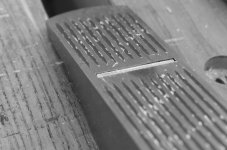
I've been thinking about this and thought that a photo might be illustrative:

waxy plane.jpg


What you can see there is bits of the lubricating candle wax in the grooves. Nothing seems to stick to the strips of sole in contact with the wood. My assumption is that resin from the wood follows suit and so there are no problems. Therefore there does seem to be an advantage of a corrugated sole over a normal one. I suspect that on older planes (my Record 5 1/2 is pre-war), there may be little imperfections on the sole in some cases which might provide a spot where a bit of resin can take hold and grow as planing goes on. The corrugated sole offers a row of lines of least resistance which probably work against this.
 
I have a No 7 (or maybe an 8 - can't quite recall as not in the w/s) with grooves. I bought it used and had no idea what the grooves were for at the time. My old cabinet maker / restorer friend (now pushing up daffodils sadly) said that in his experience the grooved soles were well worth buying because the machining quality was much better than smooth soled planes. He reckoned they were made to a higher standard twists and humps were always eradicated.

I like mine. Very good for levelling by hand. However, I don't work pine or resinous woods by hand at all. The quality available locally is poor. Maybe because in this part of the UK we have a lot of newbuilds going up and all the merchants are very focussed on that.
 
Adrian,

that's an interesting point your late friend made about the machining quality of the soles. I have wondered if the sole of my Millers Falls #5 is made from a different (harder?) steel than the sole of my Record 5 1/2. Of course I have no way of verifying that as I know zero about metallurgy. It is certainly, however, very well cut.

I'd be interested in comparing a Record corrugated plane with my 5 1/2.

The fact that modern manufacturers don't bother with corrugated soles might be indicative of something more than a wish to just keep costs down. Perhaps there is no demand for them. What I and I presume you, can say is that there is certainly no disadvantage to them.
 
Is it perhaps something to do with the sole being thicker? I have never measured the difference and I don’t have a corrugated sole to check, but I would have imagined that the corrugations would nearly go through an ordinary sole.
Ian
 
I will fish mine out when I get back and take a photo of thickness compared with a 5 1/2. Even the latter vary as I have two and one is significantly heavier and wider than the other.
 
I must admit I like corrugated soles. I had avery nice U.S. made Stanley No.6 but I sold it on - I had a 3, a 4, 2 x 4 ½ s, 2 x 5s, 2 x 5 ½ s, a 6c, a 7 and an 8, and I used the larger ones less and less so some had to go.
 
Back
Top