• Hi all and welcome to TheWoodHaven2 brought into the 21st Century, kicking and screaming! We all have Alasdair to thank for the vast bulk of the heavy lifting to get us here, no more so than me because he's taken away a huge burden of responsibility from my shoulders and brought us to this new shiny home, with all your previous content (hopefully) still intact! Please peruse and feed back. There is still plenty to do, like changing the colour scheme, adding the banner graphic, tweaking the odd setting here and there so I have added a new thread in the 'Technical Issues, Bugs and Feature Requests' forum for you to add any issues you find, any missing settings or just anything you'd like to see added/removed from the feature set that Xenforo offers. We will get to everything over the coming weeks so please be patient, but add anything at all to the thread I mention above and we promise to get to them over the next few days/weeks/months. In the meantime, please enjoy!

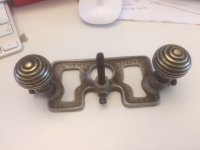
What's this tool

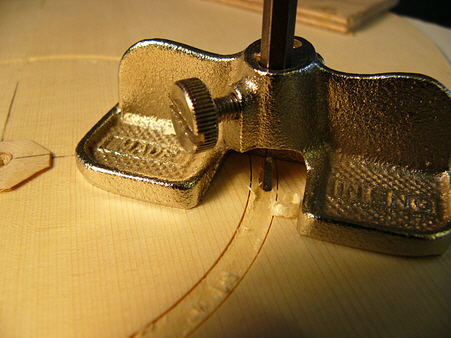
Yes, it's a router plane. Aka a "witch's tooth" (in luthiery circles anyway...) You are correct - they are used for removing material from slots where accurate control of the slot depth is required. Here seen preparing a slot in the top of an acoustic guitar for soundhole binding. The blade in this one is a repurposed allen key:

ppad9d3c2a.png
 
As selectortone has said, it's a router plane. Brilliant bit of kit. It helps make really accurate tenons, housings, half-lap joints, and so on. Use it across the grain as a final finish (ie it isn't for taking 2 or 3 mm off, it's for the final leveling........1/2mm maybe, depending on your wood).

Selectotone........the "witches tooth" types are the ones with a straight blade at approx 45 degrees, not this type with the right-angled blade with the main shaft vertical.
 
Mike G":10v50p9g said:
Selectotone........the "witches tooth" types are the ones with a straight blade at approx 45 degrees, not this type with the right-angled blade with the main shaft vertical.

The witch's tooth I used at guitar building school had the right angled blade. At least that's what it was called by my tutor who is (or was, he's dead now) an internationally renowned lute builder. Perhaps the nomenclature differs between luthiery and shed building.
 
Thank you all.
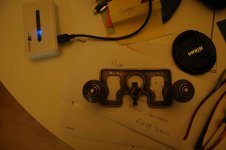
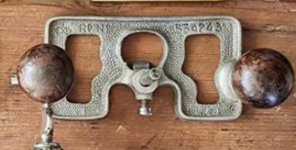
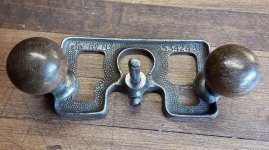
I have cleaned up the router and taken a better photo 1Router.JPGof it. Enlarge the photo.
The tool maker was a Edward Preston of Birmingham circa 1825. As the 2 brass handles have no sign of moulding marks I can only surmise they must have been individually made this leads me to believe the router must be older than the US Stanley equivalent as wood is easier and cheaper to turn.
The enhanced details clearly show the Edward Preston logo R# N#534243.

Richard
 
05792538-39FD-4407-BCAC-594379EEDBB1.jpeg

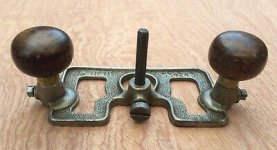
When you originally posted this my first thought was that those were metal door knobs on that plane.
If you do a search for “Edward Preston Router Plane” many of them don’t have handles. All of those that do, have wooden handles. I suspect at some point someone has replaced the lost or damaged ones with door knobs! ;) :lol:
 
Hi Woodster
It appears my router must be pre 1900.

Just dug up some info on Edward he had a son with the same name, he followed in father's footsteps he opened a brass foundry in Birmingham, maybe that is why our router has the beehive knobs. And Edward Preston Sr. (c. 1798–1883), (Probably baptised at the church of St Philip, Birmingham, on 26 March 1798), appears to have started out in business as a plane maker and was first listed as in this profession at 77 Lichfield Street in the Birmingham Directory of 1833. From other listings and advertisements, it appears that the business was actually started in 1825. Preston is likewise recorded as a plane-maker living with his family in Lichfield Street in the 1841 census, at which time his younger son Edward was 6 years old. Around 1850, his son Edward left school to join his father’s business and is recorded in the 1851 census as a plane-maker at his father’s address.


By 1864Edward Jr. appears to have started up his own “wood and brass spirit level manufactory” at 97½ Lichfield Street. By 1866, he had added planes, routers, joiners, coach, gun, cabinet and carpenters tools to his line, and the following year he moved his shop from his father’s address and relocated to 26 Newton Street, before moving again to much larger premises at 22–24 Whittall Street. This location became known as the Whittall Works and later was the office and factory of Edward Preston & Sons, Ltd.

Extract from Classic Tools
Edward Preston Sr. (c. 1798–1883), (Probably baptised at the church of St Philip, Birmingham, on 26 March 1798), appears to have started out in business as a plane maker and was first listed as in this profession at 77 Lichfield Street in the Birmingham Directory of 1833. From other listings and advertisements, it appears that the business was actually started in 1825. Preston is likewise recorded as a plane-maker living with his family in Lichfield Street in the 1841 census, at which time his younger son Edward was 6 years old. Around 1850, his son Edward left school to join his father’s business and is recorded in the 1851 census as a plane-maker at his father’s address.


By 1864Edward Jr. appears to have started up his own “wood and brass spirit level manufactory” at 97½ Lichfield Street. By 1866, he had added planes, routers, joiners, coach, gun, cabinet and carpenters tools to his line, and the following year he moved his shop from his father’s address and relocated to 26 Newton Street, before moving again to much larger premises at 22–24 Whittall Street. This location became known as the Whittall Works and later was the office and factory of Edward Preston & Sons, Ltd.

The saga carries on. If you look at Classic Tools there is even more blurb on his 3 grand children.
 
Back
Top