• Hi all and welcome to TheWoodHaven2 brought into the 21st Century, kicking and screaming! We all have Alasdair to thank for the vast bulk of the heavy lifting to get us here, no more so than me because he's taken away a huge burden of responsibility from my shoulders and brought us to this new shiny home, with all your previous content (hopefully) still intact! Please peruse and feed back. There is still plenty to do, like changing the colour scheme, adding the banner graphic, tweaking the odd setting here and there so I have added a new thread in the 'Technical Issues, Bugs and Feature Requests' forum for you to add any issues you find, any missing settings or just anything you'd like to see added/removed from the feature set that Xenforo offers. We will get to everything over the coming weeks so please be patient, but add anything at all to the thread I mention above and we promise to get to them over the next few days/weeks/months. In the meantime, please enjoy!

Breadmaking Machine

We are well set up breadwise for a long lockdown. A barrel of wheat and half a barrel of rye bought from local farmers. A small electic household mill of the Mockmill variety. Sour dough. And last but not least a lady of the house who is very good at baking.
Now I am off to hug her under the blanket.

When we use a bread making machine it is my aunt's old Electrolux Hushållsasistent which I have rebuilt.
 
I just bake bread in the oven, Until I get round to renovating/ extending the kitchen there's no space for any breadmaker/ mixers etc.

My bread making is mainly sourdough which I do in a dutch oven but also make baguettes with a long ferment over 2-3 days.

I just use a basic white flour for pizza but use 00 italian flour, mainly as I'm working through a 25kg sack of it at the moment.

I was struggling getting the bottom of my Pizzas crispy enough and now just bake them in the oven then take them out and stick them on the gas BBQ directly for a few mins as its fairly near the kitchen.

Sometimes make a batch of croissants as well.
 
Oh bread. BREAD! How I miss thee.

I'm a big bloke. Too big. And I have the medical conditions to prove it.

I've made bread for 40-odd years. I just about know what I'm doing by now. I make good bread.

I've lost 10lb since New Year,and it's been largely due to reducing my carb intake, especially bread. I really miss it. Two slices of toast and Bovril in the morning, oh heaven.

I'm not exactly wasting away to nothing, but there is a positive effect n my BMI, if not on my general demeanour.

I've had three bread machines in my time:

1) A Breville, branded Antony Worral Thompson (before he screwed up his career by biting the hand that fed him)

2) A later Breville which, quite frankly, I never got on with, they changed the programs and suggested recipes

3) A Panasonic. It's very good, but again, my preferred recipe does not fit. So I use it as a donkey to do the kneading and than bake manually in the oven.

I really miss my morning toast :(

Mr. Grumpy.
 
Well done on loosing 10lb Steve. I recon I've gained at least that over the festive period and it needs to come off. I haven't ventured near the scales to confirm, but the tight trousers are a good enough indication :oops: . I will have to go back to fasting for a couple of days a week for a while until my circumference gets back to normal.
 
Carbs are the issue, you're right Steve.

I did Keto for a while, did ok and it corrected my blood sugar enough for a medication reduction.

I love cheese, meat, cream and all that stuff but a man can only eat so much cauliflower cheese and steak before the toast/bread cravings get too much.

Kebabs were on the keto menu but I knew I was in carb trouble when I stuffed the pitta bread in my mouth, chewed it for a few minutes then spat it in the bin in same vain hope that it wouldn't count if I didn't swallow (be quiet at the back there!)

Bread was my sole weakness... I've been off keto for a couple of months now... I keep trying but.. bread, toast, buns...
 
jimmy s":1o0rc563 said:
Well done on loosing 10lb Steve. I recon I've gained at least that over the festive period and it needs to come off. I haven't ventured near the scales to confirm, but the tight trousers are a good enough indication :oops: . I will have to go back to fasting for a couple of days a week for a while until my circumference gets back to normal.

If you can hack it, the 5:2 is good place to start. Or the 16:8. I lost 20lb on the 5:2. Not too onerous either. I then fell, broke my leg, lots of soft tissuse damage and promptly put it all on again, sitting around doing nothing all day.

I have friends for whom food is just a way to avoid dying. I rahther envy their attitude. To me food is one of the main reasons for getting up in the morning.

Hake in a spicy sauce this evening. Rather splendid.
S
 
ScaredyCat":1hvqccgd said:
Carbs are the issue, you're right Steve.

I did Keto for a while, did ok ...
Bread was my sole weakness... I've been off keto for a couple of months now... I keep trying but.. bread, toast, buns...

I feel your pain.
S
 
Intermittent fasting was hell at first but honestly it got easier. I've done a couple of 48 hour stints but the wife often forces food on me because of the diabetes, although I'm pretty sure once I hit ketosis there's no real issue.

Now I'll routinely just do IF anyway just to see if I can still manage it. A bit addictive once it starts burning those kilos off. I've kind of flatlines in my weight 89Kg and it's not moving in either direction which is slightly disappointing but I'm not moving about that much, working from home.
 
I normally do 2-3 days stints at IF but wife doesn't like me doing it. Was woken up in the night getting poked in the ribs one night as she was concerned I was dead lol.

Longest stint I've done was just under 5 days.

Once you get over the initial hunger its not that bad however the urge to taste something come day 5 was getting a bit overwelming.

Fairly gets the weight off though.

Anyhow sorry for digressing
 
We’ve found one of the most important things with Pizza is using the right Tomato sauce. Traditionally San Marzano plum tomatoes are used. The closest we’ve found are Napolina peeled plum. We just add some salt and a little oil and some Basil leaves and whizz it up with a blender for a couple of seconds. Far, far better than anything you’ll ever find on a supermarket Pizza. ;)
 
I've dumped my sourdough starter, so until I can find rye bread its back to the panasonic.

Which by the way, makes extremely good pizza dough.

But we have just found that LIDL sells rolled up pizza bases. Looks like a package of aluminium foil until you study the picture closely. Unroll it into a rectangle about 20" x 10", add cheese and topping to taste and cook. Its pretty good stuff for shop bought.
 
Bob, have a look at the James Morton book - if I can make a sourdough starter with bleached white Lidl bread flour using his method, I'm sure you can too! Mind, I wouldn't have hesitated to use unbleached flour instead if it had been available.
 
I'm investigating that book with the help of Adrian, but due to my complete lack of computer skills I cant get the images he has sent expanded large enough to read.

I'm also trying to get established with amazon germany as uk deliveries to Cyprus have ground to a halt.
The quest continues.
 
Interesting that bread making is proving such a popular topic on a woodworking forum.

Like many others I first tried baking bread during lockdown, and was struck at how similar to woodworking the experience was. There's an old expression that says to master one craft is to master them all, in other words the theory runs that there's some deep grammar or syntax underpinning the craft process which is somehow transferable.

After baking for less than a year I wouldn't claim to have "mastered" the skill, or anything even close, but amidst the inevitable failures there have been enough successes to make the journey worthwhile.

I initially followed the fashion for sourdough, and eventually got enough things right that I could turn out passable loaves such as this,
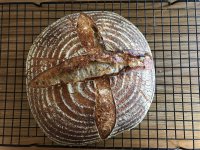
Sourdough_7477.jpg

The bigger challenge was delivering the extreme open crumb that seems to be the real litmus test. That took a bit longer, but eventually super high hydration and the knack of spotting when proving was at the absolute peak meant I could reliably turn out loaves like this,
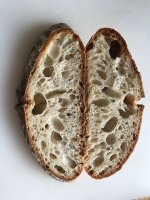
Sourdough,-Open-Crumb.jpg

But having got there I've concluded that really open crumb loaves aren't actually my favourite, they're not really the optimum for sandwiches, nor for toasting. So now I usually wind back the hydration and aim for a slightly tighter sourdough crumb (and indeed a slightly "sweeter" sourdough flavour).

One of my favourite loaves for everyday eating is a plaited Jewish bread called Challa, it's like a slightly less rich version of Brioche and it's absolutely delicious. Like all enriched breads it makes sublime toast, and the plaiting allows a "tear and share" approach that's a delight with food.
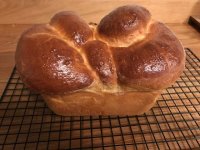
Challa.jpg

I was determined to also make traditional sourdough based Pannetone for Christmas, but I really struggled to get an acceptable result. Eventually I found a method that adds a scant half-teaspoon of instant yeast (about 2g) to the first sourdough based pre-ferment, and that was the real key to cracking the problem. I didn't quite get there by Christmas (like all craftsmen the promised dates are liable to slip!) but in January I finally produced this,
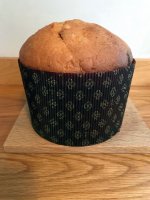
Pannetone_8430.jpg

A Pannetone with that characteristic massive rise and oven spring, which then delivers a fluffy, moist crumb that's almost cake like,
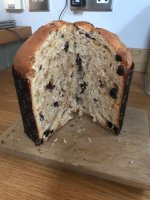
Pannetone_8432.jpg

I was lucky enough to get some advice from Italian friends, and now bake Pannetone with Tipo 00 flour, home made candied citrus peel, and the faintest hint of bergamot for complete authenticity. There are plenty of other fascinating bread adventures, from Fougasse to Flatbreads, but I'm also now beginning to experiment with Patiserrie. If bread making is the "joinery" of baking, then patisserie is surely the veneer and marquetry work!

 
My father - another electronic engineer! was at one time involved with commercial bread making project to design a dough consistency controller.
The system was heavily dependent on anaysing the power consumption profile of the mixer motor to decide the current state of the dough at the various stage of the mix.

Bob
 
That Pannetone looks great Custard. Not tried making one yet but it’s on the list. I need to get some Pannetone cases from Bakery Bits first. Not heard about the bergamot before, how much do you put in? You can’t seem to get decent dried or candied fruits anymore and my favourite, Angelica is non existent. We have been growing Angelica plants in our garden with a view to making our own but it’s quite a faff. My wife also makes ice cream so we could do with some decent fruits to make one of my favourites, Tutti Frutti. I will be making some candied or glacé orange soon as that seems straightforward if time consuming.
 
Hello Woodster, Bakery Bits does an "Aroma Pannetone" which has the right blend of citrus and bergamot. It's a tiny amount that's required, about 2 drops for a kilo of dough, but it's the "can't quite put your finger on it" essential ingredient!
 
Custard":6m8lnutk said:
Hello Woodster, Bakery Bits does an "Aroma Pannetone" which has the right blend of citrus and bergamot. It's a tiny amount that's required, about 2 drops for a kilo of dough, but it's the "can't quite put your finger on it" essential ingredient!

Ah, thanks very much for that. I’ll get some next time I place an order. ;) Someone has hinted they’d like an Orange Madeira cake today so I’ll be doing that this afternoon after some metal turning in the shed!
 
9fingers":18gz07di said:
My father - another electronic engineer! was at one time involved with commercial bread making project to design a dough consistency controller.
The system was heavily dependent on anaysing the power consumption profile of the mixer motor to decide the current state of the dough at the various stage of the mix.

Bob

That's interesting. I've heard that the "Chorleywood Process", which revolutionised industrial bread making in the 60's, was really about chucking in massive amounts of energy via both heat and extremely aggressive kneading, which in combination accelerated baking into a linear, production line process instead of a batch process. An unfortunate by product was that it removed most of the delicious taste and wonderful texture!
 
The Chorleywood process is still batch based, but what the higher temperatures and extreme aggression do is get the initial air bubbles into the dough by mechanical means instead of requiring bulk fermentation. That means you can use lower-quality flour (since the fermentation would normally consume some of the protein content, skipping that means you need less protein to begin with) and skip that multi-hour fermentation entirely, going essentially straight from the mixer to the baking tin for final proof. Combined with artificially cooling the loaves after baking, they can go from raw ingredients to packaged and ready to ship in around 3-4 hours.

Given what most home bakers discover about the relationship between fermenting time, texture, and flavour, it's not hard to see why the results are so mediocre. Given the time and money savings in the process, it's also not hard to see why it's so ubiquitous.

A minor aside is that the higher temperatures aren't achieved by heating the mixer - all the heat is generated by the mechanical stresses placed on the dough by the sheer speed of the mixing. In fact a lot of these machines have cooling jackets to prevent the dough getting too hot during the process.
 
^^. Very interesting post. I wondered how commercial bread could be so aerated and be produced so quickly. I was surprised to learn recently that many supermarket breads sold as sourdough, are not made using a natural fermentation process either.

Super impressed with Custard's efforts. I've tried most styles of baking over the past couple of years and generally find that anything worthwhile flavour wise takes time. I agree with Gary that too many air bubbles make sourdough that is sub-optimal for sandwiches. I deal with this via the proving process.

Making a fermented loaf takes me two days: make the dough and autolyse at beginning of day one, stretch it a few times during the day, rest, retard overnight in Bannetons in the fridge, and bake the following morning in lidded cast iron pans. Really once baked it needs leaving a day to mature and develop flavour. I do 4 at a time.

We never buy supermarket bread now. My wife is German and she recently bought a dark brown dark rye sourdough from an "artisan bread maker" who operates on Saturdays from a market stall in Sevenoaks High Street, opposite our opticians (and close to Waitrose). So she bought it for £4. (ie 8 times what it costs me to make a sourdough loaf of similar size....). She was full of anticipation, but the following week she was back at the stall saying it did not resemble any German bread she has ever eaten, did not taste of sourdough and had no flavour. To my surprise, the baker (who I naively thought baked his own loaves) said he bought them in from a commercial baker, but would pass her comments on. She got four free croissants in compensation. :lol:
 
Some supermarket breads apparently have some interesting additives to improve the flavour.


“It has been reported that most of the hair used to make L-Cysteine comes from China, where it's gathered from barbershops and hair salons. You can avoid L-Cysteine by buying fresh bread from a local baker, as it is not an additive in flour.”
 
AJB Temple":c5hlr30f said:
I was surprised to learn recently that many supermarket breads sold as sourdough, are not made using a natural fermentation process either.

I believe the trade description of "sourdough" is pretty loose, so only the merest trace of a starter is sufficient to meet the standard. Consequently most commercial sourdough loaves basically use normal yeast, a tiny drop of dried sourdough starter, and the sour flavour comes from vinegar or artificial flavourings!

There's a great description of supermarket bread making in Andrew Whitley's book, he says it's a "tanning booth for bread", basically pre-made industrial loaves are shipped in and given a quick warm up in the store!
 
I’m going to be controversial and say that I don’t like the taste of sourdough bread. I went to San Francisco a few years ago and everything was sourdough this and quinoa that. I just thought, I’d love some crusty bread and cheddar cheese.

I haven’t bought a loaf of bread for six years now. I S tarted with a Panasonic breadmaker, but moved on to baking by hand when I have the time, and making the dough in the breadmaker/baking in the oven when I don’t.
 
Oddly enough I don't bake by hand. I usually do 4kg of dough each bake (2 lots of 2kg), and this is in a mixer with a dough hook. Quite brief and in two stages (first mix the ferment, flour and water until combined - maybe two minutes. Autolyse (just leave it) then after 30 mins to an hour add the salt and mix again in the machine for a minute or so. Then leave all day in the mixer bowls. No kneading - just a couple of stretches by hand. Then turn out, stretch with the flat blade thing, leave for 30 mins to rest, then into the bannetons and into the fridge overnight.

I think bread making machines with the little paddle in the bottom greatly overwork the dough.
 
AJB Temple":1mjfmxep said:
I usually do 4kg of dough each bake

Presumably you're freezing some of your output? If so, how long do you find bread keeps in the freezer, and how do you handle de-frosting?
 
Yes, Gary. I bake one loaf a week for the old lady down our lane who is very worried about Covid, one is out to eat and two are frozen. I let the loaves cool from the oven, tipped up on a wooden spoon handle to give airflow, then each one goes in a cloth draw string baking bag (bought several on line). The ones for freezing go into the freezer in these bags.

I rarely freeze bread for more than two weeks. When a loaf comes out, it takes a morning to defrost in its bag, and then is usable. Tastes perfectly fresh and although some people say you lose 5% of flavour, frankly I can't tell the difference and neither can my wife.

We don't eat bread fresh from the oven unless I've screwed up my production cycle, as I think it tastes better and just easier having sat for a day.

I used to bake in smaller quantities and more often, but I find that doing a batch is very time efficient as the oven is already hot and so are the cast iron dishes I bake in, and then I cook lunch in the cooling down oven! Luckily I have two bowls for the Kitchen Aid mixer so that saves me a bit of time on dough days.

For anyone new to baking I also highly recommend a proper digital bakers scale. Makes consistency easier, and it is critical to get things like salt quantity correct. Baking bread is really very easy.
 
I've seen it said - though I can't remember where - that freezing for up to a few weeks and thawing overnight is roughly equivalent to a day of room temperature storage, as regards freshness or staleness. I don't know the basis for that estimation, and having forgotten the source I can't go back and look, but it does seem consistent with my experiences. I think I could tell the difference between a completely fresh loaf (which for me means baked in the evening, then eaten at breakfast) and a frozen and defrosted one, but once it's a couple of days old I'm not sure there's much in it.
 
Villa Chemist":1jjcwcww said:
I’m going to be controversial and say that I don’t like the taste of sourdough bread. I went to San Francisco a few years ago and everything was sourdough this and quinoa that. I just thought, I’d love some crusty bread and cheddar cheese.
I like sourdough in the situations where it works, but that's not everywhere. For me that means I haven't made it in about ten years because it's not generally what I want at home, but I'll quite happily have a sourdough-based creation in a café (in times when such things exist, of course). I think that applies equally to both the flavour and texture aspects.
 
AJB Temple":flscg446 said:
I let the loaves cool from the oven, tipped up on a wooden spoon handle to give airflow, then each one goes in a cloth draw string baking bag (bought several on line). The ones for freezing go into the freezer in these bags.

Some useful tips there. Thanks.

You've also given me food for thought about increasing the batch size, I'll have to think the logistics through but using a pre-heated oven and dutch ovens (I also use these) makes so much sense I'm kicking myself for not considering this before!
 
I confess that I’m not over keen on the taste of sourdough. It does have a lovely chewy texture though that you don’t seem to get with other breads. I’ve also tried what some folks call half white half sourdough but I’m still not keen. Maybe one day though I’ll get to try one that I like.
 
Have you tried ordinary breadmaking bread, but with half wholemeal flour and half white flour?
A good compromise. Its reasonably light, unlike brown bread, but tasty enough as toast or a sandwich.
 
Custard":6bqev0rl said:
9fingers":6bqev0rl said:
My father - another electronic engineer! was at one time involved with commercial bread making project to design a dough consistency controller.
The system was heavily dependent on anaysing the power consumption profile of the mixer motor to decide the current state of the dough at the various stage of the mix.

Bob

That's interesting. I've heard that the "Chorleywood Process", which revolutionised industrial bread making in the 60's, was really about chucking in massive amounts of energy via both heat and extremely aggressive kneading, which in combination accelerated baking into a linear, production line process instead of a batch process. An unfortunate by product was that it removed most of the delicious taste and wonderful texture!

I think it would have been in mid to late 60s. One of the key drivers commercially was to get about as much water into the dough as possible before it turned into a soup. More water as it was free! I was in my teens then and not really interested in much around me and the old man is no longer around to ask.

Bob
 
sunnybob":2ezzzhuf said:
Have you tried ordinary breadmaking bread, but with half wholemeal flour and half white flour?
A good compromise. Its reasonably light, unlike brown bread, but tasty enough as toast or a sandwich.
That's what I do in my Panasonic but with the addition of some malted grain flour, so it's equal measures of (Waitrose organic) strong wholemeal, white and malted, which produces a very pleasant, munching sort of bread - Rob
 
For what it is worth, I’m with the others that aren’t that keen on sour dough all the time.

The basic recipe I use is 70% min. hydration, autolyse (I actually put the salt in with the flour – they say you shouldn’t, but let them say) for an hour, add yeast, knead (well mix) very briefly, put it in a covered bowl, thinly coated with olive oil, let it rise over night in the ‘fridge, fold over itself a couple of times (ie don’t really knock it back), let it rise again on a baking sheet at room temp, cut and bake pretty hot.

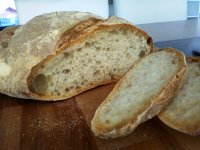
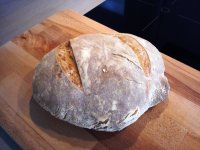
Gives you this.

Bread 0.jpg

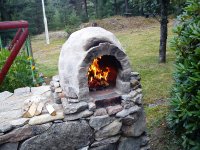
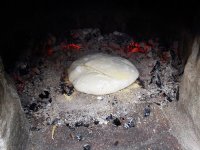
Even when baked in this.

Bread 1.jpg

Bread 2.jpg

Bread 3.jpg

Makes good pizza dough too.

Although this doesn’t help those decadent fops with breadmakers.

Other yeast based products are available.

Saffransbullar med mandelmassa.jpg

Bread 5.jpg

And I even had a go at some of these for the first time last week. I need more turns on the escargot, but they tasted nice.

Bread 6.jpg
 
I made a nice Orange & Sultana Madeira cake this evening. It won’t last long. :D
 
The bread maker is a kitchen gadget. I dont really do kitchen gadgets, normally im the bloke with a pan a chopimg board and a decent knife. I dont tend to bother with auto graters, magic stirrers, whisk wipes and avocado knifes.

But the bread maker deserves to be had. I can go to bed and wake up with fresh bread for breakfast. I am happy to make a loaf by hand, but o need an hour in the morning to bake it, Which for me whould mean being up at 5 to make the loaf before heading to work. Simply not going to happen.
Our local bakers is open with fresh bread from 7. Not as good as slipping it off the rack on your way home on Saturday morning but not bad for a commercial enterprise.
 
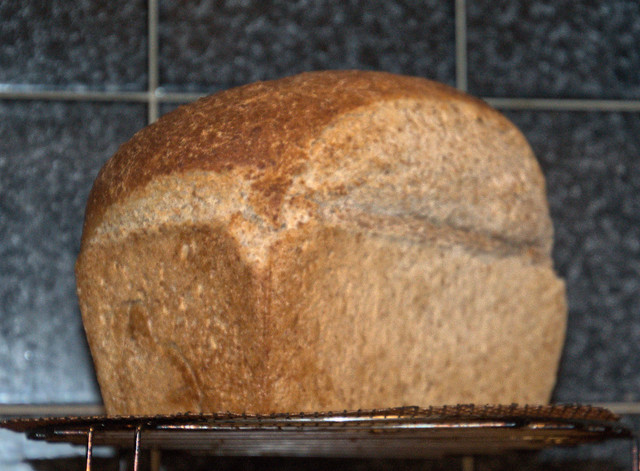
This is my standard 50% wholemeal loaf. I make the dough in the Panasonic, then bake it in a halogen oven. Pouring boiling water into the oven before I start baking means the bread steams in a similar way to that of a commercial baker's oven.


My lame let me down this time but at least the photo shows how much the bread rises whilst baking.
 
Back
Top