I recently mentioned that I was working on some Windsor chairs, and said I'd post a photo. I don't want to ambush another thread so I'll start a fresh one.
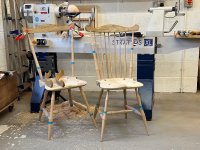
I completed one set of Windsor chairs last year and that's led to another commission of eight chairs. This time for a "harlequin set" in other words a collection of chairs with small differences in style or colour, so reminiscent of an antique set that was collected over a number of years.
Windsor chairs fall into a small but interesting woodworking category, in that they're actually a lot easier to make than you might think!
In that respect they're similar to bowl turning and box making. All three being areas where enterprising individuals offer the beginner the opportunity of a two day to two week long course, at the end of which the beginner has made a bowl, or a box, or a Windsor chair.
In a world of instant gratification that's gold dust, especially when measured against a seven year apprenticeship!
Before anyone gets offended, you can of course spend a lifetime making ever more challenging bowls, boxes, or Windsor chairs. But, almost uniquely in woodworking, it's also possible to produce a perfectly acceptable example of these, with no previous experience, and after just a few days tuition.
But there are some catches.
With Windsor chairs sourcing the timber can be problematic. Few people will be able to find freshly felled trees to cleave into blanks. And traditional English style Windsors require 16" wide boards of 2" thick Elm, good look finding those in B&Q!
Plus if you really want to make something special you'll probably want Yew for the other components. But what isn't generally realised is that it's not field grown Yew with wandering grain that you're really looking for, it's coppice grown Yew poles. Which in my experience could be fairly described as "unobtanium".
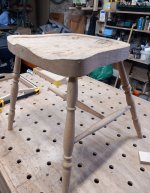
Bottom line is that your chances of a successful project are massively improved if you ensure your design fits with the real world woods that you can actually source. These Windsor side chairs for example have only one steam bent component, the crest rail (you can see two more crest rails for the next batch resting on the seat of the chair on the left). This modest radius of curvature means they can even be made from kilned timber provided it's pre-soaked and is a really good bending timber such as Ash or Oak.
I do make arm chair Windsors with more complex bends, but again I try and avoid the hassle of using green wood. I've found air dried Oak or Ash, pre soaked, delivers a reasonable percentage of successful bends, not quite the 95% plus I'd expect from green wood, but certainly 80% or better, which is good enough for me. Furthermore, there are yards where air dried Oak, Beech, and Ash are readily available. Often times recently put into stick so really pretty wet. Where I live in the New Forest I'd recommend Gouldens for this, but similar small traditional yards exist all over the country if you know where to look.
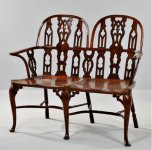
Sticking with the theme of the design and construction being guided by timber availability, you need to think hard about your seats. I first started making Windsors in the Dutch Elm disease era, there was an absolute glut of Elm. I put aside some fabulous wide, thick boards of English Elm (so not the more straight grained Wych Elm) and I've got enough left for maybe a dozen traditional English Windsors, including some long boards that deserve something really special, maybe a gothic windsor settee?
But back to practicalities. In my opinion the best widely available timber for Windsor seats is Poplar, or as it's sometimes called Tulipwood. But there are still two problems. First you're unlikely to find a wide enough board for a single board seat. And secondly Poplar is a nasty looking timber with streaks of greenish brown colour running through it. These two problems aren't insurmountable, you can joint a seat where the grain is matched in such a way that the join's almost invisible (spoiler alert, the best way of doing this is to source a two boards each a bit wider than half the finished seat, you rip one board down the middle, flip the pieces over and joint them to the outside of the uncut board). And the colour issue can be fixed by a two pack bleach, exposure to sunlight, fuming, or staining. However, my favoured solution is milk paint. It's bang on trend, can be co-ordinated with the client's decor, and instantly unifies disparate timbers.
Another issue that needs resolving before you begin is the tools.
Let's start with saddling the seat. You can spend an absolute fortune on this, with specialist tools like scorps, gutter adzes, and travishers. I'm not saying these don't have a role, but for the first few chairs they're not absolutely necessary. If you go on a Windsor chair making course you'll probably use these tools, and then you may well conclude that they're essential. In truth a big old out-cannel gouge and a french curve scraper will get the job done. Incidentally I say out-cannel just because it's about a thousand times easier to sharpen than in-cannel, and I'd rather have a sharp tool than the perfect tool anyday!
Then you've got the question of the spindles. Do you turn them or do you shave them? Personally I much prefer shaving or "whittling" with a drawknife and a spokeshave. I'm not the world's best turner but the only way I can turn spindles is with greenwood which cuts like butter. But then you've got the giant hassles of sourcing greenwood and of drying the spindle ends for accurate tenons. Plus I also prefer the "faceted" shape of shaved spindles, and you can make these with kilned or air dried timbers.
Incidentally, many people assume you can only rive or split out blanks from wet wood. Not true. If you select your timber in person and pick out really straight grained boards it's practical to rive spindle blanks from kilned timber. And then you can get the super thin spindles that really give a Windsor it's sprightly elegance. Furthermore, you really don't need a shave horse for this. I first learnt to make Windsors in the Mike Dunbar era, and he held his blanks in a vice rather than a shave horse, so that's what I've always done.
One final point about shaving. Personally I'd rather do the entire job with a couple of good spokeshaves rather than a bad drawknife. The problem with most used drawknives is that the backs are pitted, which makes sharpening them almost impossible. By all means do look, good used examples can occasionally be found, but be realistic. The hard fact is that most of the old drawknives on Ebay will never make an efficient or accurate tool.
I could keep banging on about this stuff for ages, but it's time for dinner, so I'll break here and pick this up later when I get a moment.
Cheers everyone!
I completed one set of Windsor chairs last year and that's led to another commission of eight chairs. This time for a "harlequin set" in other words a collection of chairs with small differences in style or colour, so reminiscent of an antique set that was collected over a number of years.
Windsor chairs fall into a small but interesting woodworking category, in that they're actually a lot easier to make than you might think!
In that respect they're similar to bowl turning and box making. All three being areas where enterprising individuals offer the beginner the opportunity of a two day to two week long course, at the end of which the beginner has made a bowl, or a box, or a Windsor chair.
In a world of instant gratification that's gold dust, especially when measured against a seven year apprenticeship!
Before anyone gets offended, you can of course spend a lifetime making ever more challenging bowls, boxes, or Windsor chairs. But, almost uniquely in woodworking, it's also possible to produce a perfectly acceptable example of these, with no previous experience, and after just a few days tuition.
But there are some catches.
With Windsor chairs sourcing the timber can be problematic. Few people will be able to find freshly felled trees to cleave into blanks. And traditional English style Windsors require 16" wide boards of 2" thick Elm, good look finding those in B&Q!
Plus if you really want to make something special you'll probably want Yew for the other components. But what isn't generally realised is that it's not field grown Yew with wandering grain that you're really looking for, it's coppice grown Yew poles. Which in my experience could be fairly described as "unobtanium".
Bottom line is that your chances of a successful project are massively improved if you ensure your design fits with the real world woods that you can actually source. These Windsor side chairs for example have only one steam bent component, the crest rail (you can see two more crest rails for the next batch resting on the seat of the chair on the left). This modest radius of curvature means they can even be made from kilned timber provided it's pre-soaked and is a really good bending timber such as Ash or Oak.
I do make arm chair Windsors with more complex bends, but again I try and avoid the hassle of using green wood. I've found air dried Oak or Ash, pre soaked, delivers a reasonable percentage of successful bends, not quite the 95% plus I'd expect from green wood, but certainly 80% or better, which is good enough for me. Furthermore, there are yards where air dried Oak, Beech, and Ash are readily available. Often times recently put into stick so really pretty wet. Where I live in the New Forest I'd recommend Gouldens for this, but similar small traditional yards exist all over the country if you know where to look.
Sticking with the theme of the design and construction being guided by timber availability, you need to think hard about your seats. I first started making Windsors in the Dutch Elm disease era, there was an absolute glut of Elm. I put aside some fabulous wide, thick boards of English Elm (so not the more straight grained Wych Elm) and I've got enough left for maybe a dozen traditional English Windsors, including some long boards that deserve something really special, maybe a gothic windsor settee?
But back to practicalities. In my opinion the best widely available timber for Windsor seats is Poplar, or as it's sometimes called Tulipwood. But there are still two problems. First you're unlikely to find a wide enough board for a single board seat. And secondly Poplar is a nasty looking timber with streaks of greenish brown colour running through it. These two problems aren't insurmountable, you can joint a seat where the grain is matched in such a way that the join's almost invisible (spoiler alert, the best way of doing this is to source a two boards each a bit wider than half the finished seat, you rip one board down the middle, flip the pieces over and joint them to the outside of the uncut board). And the colour issue can be fixed by a two pack bleach, exposure to sunlight, fuming, or staining. However, my favoured solution is milk paint. It's bang on trend, can be co-ordinated with the client's decor, and instantly unifies disparate timbers.
Another issue that needs resolving before you begin is the tools.
Let's start with saddling the seat. You can spend an absolute fortune on this, with specialist tools like scorps, gutter adzes, and travishers. I'm not saying these don't have a role, but for the first few chairs they're not absolutely necessary. If you go on a Windsor chair making course you'll probably use these tools, and then you may well conclude that they're essential. In truth a big old out-cannel gouge and a french curve scraper will get the job done. Incidentally I say out-cannel just because it's about a thousand times easier to sharpen than in-cannel, and I'd rather have a sharp tool than the perfect tool anyday!
Then you've got the question of the spindles. Do you turn them or do you shave them? Personally I much prefer shaving or "whittling" with a drawknife and a spokeshave. I'm not the world's best turner but the only way I can turn spindles is with greenwood which cuts like butter. But then you've got the giant hassles of sourcing greenwood and of drying the spindle ends for accurate tenons. Plus I also prefer the "faceted" shape of shaved spindles, and you can make these with kilned or air dried timbers.
Incidentally, many people assume you can only rive or split out blanks from wet wood. Not true. If you select your timber in person and pick out really straight grained boards it's practical to rive spindle blanks from kilned timber. And then you can get the super thin spindles that really give a Windsor it's sprightly elegance. Furthermore, you really don't need a shave horse for this. I first learnt to make Windsors in the Mike Dunbar era, and he held his blanks in a vice rather than a shave horse, so that's what I've always done.
One final point about shaving. Personally I'd rather do the entire job with a couple of good spokeshaves rather than a bad drawknife. The problem with most used drawknives is that the backs are pitted, which makes sharpening them almost impossible. By all means do look, good used examples can occasionally be found, but be realistic. The hard fact is that most of the old drawknives on Ebay will never make an efficient or accurate tool.
I could keep banging on about this stuff for ages, but it's time for dinner, so I'll break here and pick this up later when I get a moment.
Cheers everyone!












 bscene-drinkingcheers: