Cabinetman":2nrdvme0 said:
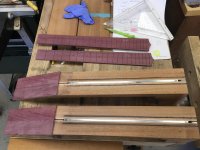
Seems a strange way of going on, you put carbon fibre rods in to stop it bending and then apply a steel rod to bend it, but I’m sure you know what you’re doing.
I know, it does seem counterintuitive.
Historically, un-reinforced necks have had truss rods of various types, single-action, dual action, fitted to counteract the tension created by the strings. I seem to recall posting in my 12 String thread that the force created by the strings was something in the region of 250lbs. I can't recall exactly, but it's substantial.
This causes the neck to bend, or rather curve, close to the nut end, which to a certain extent is desirable, because the strings need to vibrate unimpeded. Although they may look like they're vibrating side to side, I believe they vibrate round and round. So they need to be a certain distance from the fretboard, so they don't buzz against the frets.
The necks being wood respond to changes in temperature and humidity, and so the truss rod was used to adjust the curve in the neck.
As modern materials become available, luthiers try different materials to see what improvement can be made to the issue with bending necks. So the CF is used to stabilise the neck, and the truss rod is used to fine tune that curve to let the stings vibrate unimpeded as close to the fretboard as possible, so the player uses less effort in his fingers fretting the strings.
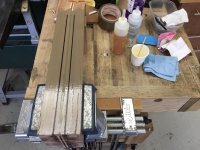
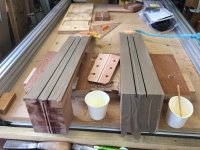
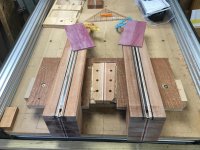
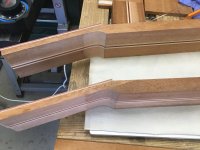
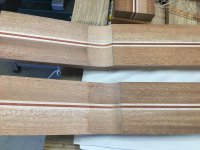
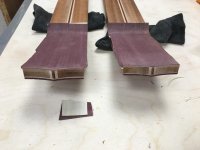
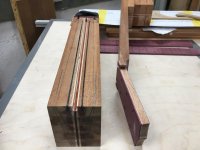
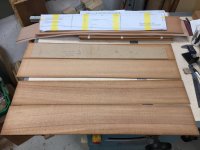
The design and construction of necks is a big subject. I choose to laminate my necks, because the one piece combination of headstock, neck and heel is expensive wasteful of timber. Also, I rip the primary timber in two and flip one piece and insert decorative, but stabilising, strips in between, balancing out the angle of the grain. As you have seen, I also create the heel from the offcuts of the laminated slab. Unless perfectly quarter sawn, any slab can have a tendency to twist with changes in humidity and temperature and combine that with the string tension, some instruments can become unplayable.