RogerS":2xfdhffs said:If anyone is interested in how you actually go about making the wreath from a drawing then take a look at this guys work. For the 'How to' scroll right down to the bottom.
Pity he is in the USA
Which guy...?

RogerS":2xfdhffs said:If anyone is interested in how you actually go about making the wreath from a drawing then take a look at this guys work. For the 'How to' scroll right down to the bottom.
Pity he is in the USA

TrimTheKing":3vwq9mjm said:RogerS":3vwq9mjm said:If anyone is interested in how you actually go about making the wreath from a drawing then take a look at this guys work. For the 'How to' scroll right down to the bottom.
Pity he is in the USA
Which guy...?


Malc2098":1bz1k1p2 said:
RogerS":2umdbt8p said:Malc2098":2umdbt8p said:
Oooh...that's clever, Malc. Is the 'tag' included somewhere in the blog or was it your jiggery-pokery ?

AndyT":138t7lox said:There's a big jump at the end of that photo sequence. I sort of understand now about making the twisted wreath, with ends at right angles and sides vertical. But how will you get the profile shaped? The Vietnamese workers chose a profile they could make with an angle grinder. The one you want is nicer, but probably harder. From knowledge of old tools, I think the next step would be rebating, probably with short, curved planes, then shaves and carving tools. What do you have in mind?


Mike G":h9q2oefk said:Roger, I would start with the spindles. Mocking up the top of the spindles in situ gives you a series of non-negotiable points. You have no choice but to connect them.
spb":17kfxyx2 said:I think what I'd do at this point is to go back to the beginning of the tangent method. The initial attempt didn't work out because the lines of the two straight handrails don't intersect so there's no oblique plane to work in. However, you can change that - shape an upward and downward bend on the two ends while keeping the same line in plan, so that the new lines do intersect. Then you can use the tangent layout to shape the wreath.
AndyT":3u64gufz said:..... Ignore the Vietnamese lads winging it with an angle grinder. .....


Robert":2epig8bl said:I've only watched a couple of videos out of curiosity. I didn't understand 'mold' either but in my mind I changed that to 'template' as in something that gives the cutting lines in one plane (or call it view or elevation).... and that seemed to make more sense. I could well be wrong of course
spb":1w9mfuml said:.....However, you can change that - shape an upward and downward bend on the two ends while keeping the same line in plan, so that the new lines do intersect. Then you can use the tangent layout to shape the wreath.
RogerS":27q216q9 said:OK...outstanding questions...
2) I'm confused about the two terms 'face mold' and 'falling mould'. "Custom Handrails' refers to both. But I can find no reference in the '101 Guide to tangent handrail drawing' ( shown here to the falling mold.
And as this is my 'bible' for doing the drawing, I can't see how or where I get the falling mold from.


Yes.RogerS":2sjy00sn said:spb":2sjy00sn said:.....However, you can change that - shape an upward and downward bend on the two ends while keeping the same line in plan, so that the new lines do intersect. Then you can use the tangent layout to shape the wreath.
The slope given by these bends will become the two new pitch lines, yes ?
Not quite - the idea of the curved up/down sections is to change the pitch angle going into the wreath to make it line up, not to take up the height difference in those sections. The wreath would be spanning the height difference; you'd just be using the curves to smooth the join.RogerS":3bxj568a said:Let us assume that the height difference is 115mm (NB arrow should be shown extended to the top of the upper pitch line piece) then, if I follow you correctly, this is the amount that the combined drop on the curve down on the top handrail and curve up on the lower handrail should be. Trouble is, I think, dropping the curve on the top handrail will take it below the permitted 900mm.
spb":ywpj6pv2 said:.......
I think what I'm getting at here is:
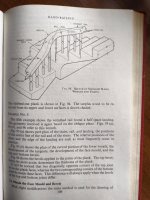
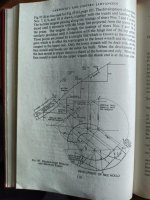
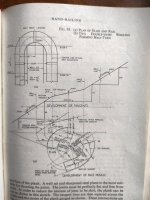
- In plan view, identify your intersection point. This is just where the centre lines of your two straight sections would cross if extended, and is point V in the instructions linked from the other thread.
- Still in plan view, choose the end points of your wreath where it'll join the straight sections. I assume we measure length to the centre point of the straight section ? These should be equal distances from the intersection point. These are A and B
- Identify the height of the intersection point. I assume that this is a 'virtual' position since the centre lines don't actually meet in the vertical plane as discussed previously ?This wants to be chosen such that the pitch lines on either side have the same slope; again, using the centre of the straight section as the reference point ?since VA and VB are the same length, this will be half the height difference between them. This is where V0 will be.
- Now you've got the horizontal and vertical dimensions that will define your pitch lines. Your pitch angle is then arctan(height / base), and you can construct the tangent drawings from that.



Good question - I imagine centre or top would work provided you're consistent throughout. I'd go back and look at the instructions from earlier to see which method they use, and stick with it.RogerS":34klo4l0 said:[*]Still in plan view, choose the end points of your wreath where it'll join the straight sections. I assume we measure length to the centre point of the straight section ? These should be equal distances from the intersection point. These are A and B
[*]Identify the height of the intersection point. I assume that this is a 'virtual' position since the centre lines don't actually meet in the vertical plane as discussed previously ?This wants to be chosen such that the pitch lines on either side have the same slope; again, using the centre of the straight section as the reference point ?since VA and VB are the same length, this will be half the height difference between them. This is where V0 will be.

Almost - you've got, potentially, three curved pieces in play: the wreath, and two easing pieces. The wreath is in an oblique plane, but the two easing pieces are each in a vertical plane and only need to curve in the vertical direction. While they may warrant their own drawings, they don't need the complexity of the tangent layout.RogerS":28qpse8q said:What you write makes all the sense in the world. However if you think about how to get there, it seems to me that it has to be done in several drawings because your explanation involves several different oblique planes at differing angles, surely ?


